











Official inauguration of Luminus wind turbines at the Jan De Nul site in Zelzate
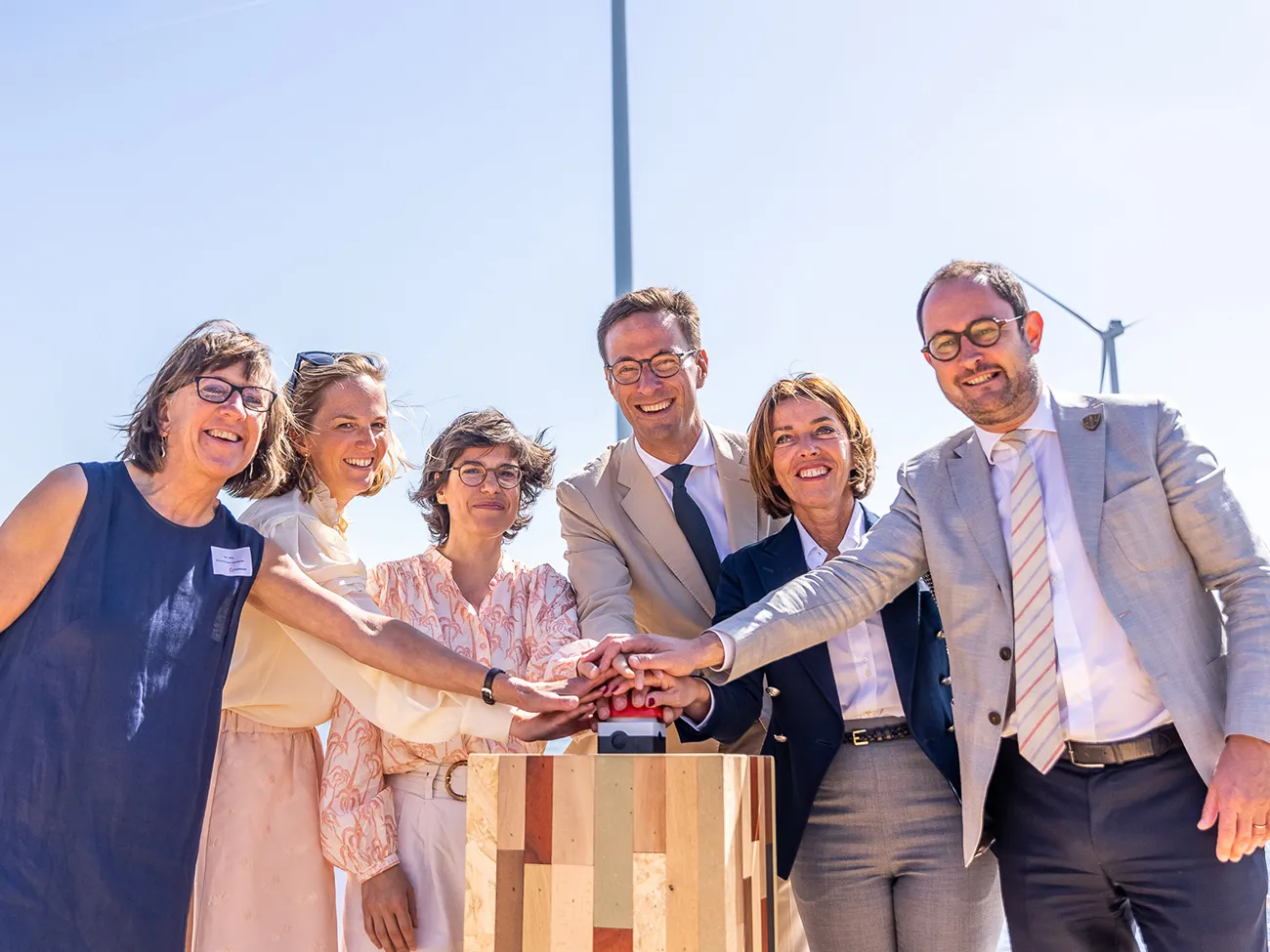
Official inauguration of Luminus wind turbines at the Jan De Nul site in Zelzate, attended by Carina Van Cauter, Governor of East Flanders, and ministers Vincent Van Quickenborne and Tinne Van der Straeten
At a glance
- Luminus and Jan De Nul are joining forces: Jan De Nul is making a site in Zelzate available to Luminus to build and operate two 3.45 MW wind turbines.
- Both companies are playing a pioneering role in the energy transition.
- Jan De Nul intends to continue along this path by developing similar projects at all its sites.
On the occasion of International Wind Day, the Governor of East Flanders, Carina Van Cauter, the Deputy Prime Minister and Minister of the North Sea, Vincent Van Quickenborne, and the Minister for Energy, Tinne Van der Straeten, officially inaugurated today the two wind turbines built by Luminus at the Jan De Nul Group site in Zelzate. These turbines contribute to the Jan De Nul Group’s ‘Code Zero’ programme, which aims to achieve the following goals: Zero violations, Zero waste, Zero emissions and Zero accidents.
Pioneering the energy transition
Luminus and Jan De Nul are both playing a pioneering role in the energy transition. Luminus has invested more than €1 billion in renewable energy projects over the past ten years, primarily in wind power. With 273 onshore wind turbines by the end of the year, the company will have an installed capacity of more than 700 MW, doubling its installed capacity in five years. The Luminus wind farm will thus produce 1,300 GWh of green energy, equivalent to the consumption of 370 000 households. This makes Luminus Belgium’s number one in onshore wind power for the seventh consecutive year.
Grégoire Dallemagne, CEO of Luminus: “The current geopolitical situation shows us more than ever that renewable energy, including wind power, has an important role to play in the energy transition. If we are to meet the 2050 climate targets, we must fully embrace electrification. Electricity is the only form of energy that can be produced on a large scale in a CO2 -neutral way or with limited CO2 emissions. Our wind power ambitions therefore fit perfectly with our mission: to build a CO2-neutral energy future that reconciles protection of the planet, wellbeing and economic development through electricity and innovative solutions and services. To meet this challenge, we need support and a robust regulatory framework, as obtaining permits for our wind projects is becoming increasingly difficult.”
Jan De Nul also plays an important role in the energy transition. Although Jan De Nul may be best known to the general public as a civil engineering and marine construction company, global energy and sustainability challenges have led it to develop an exceptionally broad range of activities in recent years. For example, Jan De Nul connects electricity grids in different countries around the world by installing interconnectors, submarine cables that can be hundreds of kilometres long, to balance electricity supply and demand. Jan De Nul also uses its specialist vessels to support energy production by building offshore wind farms, an activity that has developed rapidly in recent years, both technologically and in terms of scale. Only a handful of companies worldwide are able to design, develop and build such installations, and Jan De Nul is one of them.
Julie De Nul, CEO of Jan De Nul Dredging nv: “Today’s energy transition is first and foremost an electricity transition. To provide the electricity supply needed worldwide, the industrial chain will have to overcome numerous challenges. At Jan De Nul, we are proud to contribute to this growth through our international activities. We not only install the necessary infrastructure at sea, but also provide space for green electricity generation on land, at our permanent sites and project sites. Examples include the Zonneberg, our own office buildings and the Luminus wind turbines installed at our site in Zelzate. We are pleased with this partnership and intend to continue along this path by developing similar projects at all our sites. Together, we will thus be fully committed to the energy transition.”
100% green, locally generated energy
The two wind turbines officially inaugurated today at Jan De Nul in Zelzate were built at the company’s site in Karnemelkstraat in late 2021. With an installed capacity of 3.45 MW each, they generate a combined total of around 17 100 MWH per year, equivalent to the consumption of more than 4 500 households. The locally generated green energy represents an annual reduction of around 3 625 tonnes of CO2 emissions compared with the Belgian energy mix.
Wind power in the port area of Ghent
The inauguration of the wind turbines was preceded by a boat trip through the canal area. In addition to the ministers, other political figures, business leaders and stakeholders took part in the excursion. From the water, the ministers and 100 other guests were able to view the wind turbines at the Jan De Nul site in Zelzate.
Carina Van Cauter, Governor of East Flanders: “The Ghent Canal Zone is an area of cooperation where the focus is not on tonnage, but on added value and reducing CO2 emissions. Not so long ago, sustainability was seen as a risk and a cost, but today it stands for opportunity and economic growth. Thanks to the convergence of various industries, the Ghent Canal Zone is ideally placed to play a pioneering role in this respect.”
Tinne Van Der Straeten, Federal Minister for Energy: “Increasing the share of renewable energy is the way out of the energy crisis. If we are to protect our economy, citizens and businesses from rising prices, we must accelerate the energy transition. That means taking every opportunity available to us. Luminus and Jan De Nul are leading companies in the energy transition, turning ambitious plans into reality. Generating energy from renewable sources is good for people’s wallets, helps reduce CO2 emissions and strengthens our energy independence. Success will depend entirely on partnerships such as this one between Luminus and Jan De Nul. Cooperation between policymakers, businesses and citizens will also be decisive.”
Vincent Van Quickenborne, Deputy Prime Minister and Minister of the North Sea: “The North Sea is becoming the driving force behind our energy independence. We rank 6th in the world in terms of the number of wind turbines. We will triple this capacity by 2030 and even quadruple it by 2040. That is why we are ensuring the optimal use of space, installing more powerful wind turbines and investing in new, innovative technologies. This will ensure that every Belgian household is supplied with green energy from our North Sea. But that is not all. We also want to make our country the first in the world to install floating solar panels at sea. We will invest heavily in this area in the years ahead. Finally, algae will be converted into a source of biofuel. The North Sea gives our country the momentum it needs to become independent of Russian gas.”
Question about this story? Ask your question
Keep following this
Get an email when a new story is published. No account needed.
- SubjectNews







