











New regulations for roadworks signage in Wallonia

Over 20 years, signage equipment and methods have evolved.
The reform of roadworks signage, which came into force on 1 March 2021, is intended to improve safety for both workers and road users while also keeping traffic flowing. The new regulations focus on the safety of pedestrians and cyclists, making roadworks more visible and ensuring that the road is shared considerately.
Greater attention is being paid to pedestrian and cyclist traffic in built-up areas. Any changes to pedestrian and cycle routes must be designed to ensure they are comfortable to use, avoiding kerbs, cable crossings and holes; keeping diversion routes as short as possible; making them suitable for people with reduced mobility or visual impairments; and ensuring they are safe in relation to motor traffic and activity on the worksite.
Making roadworks more visible
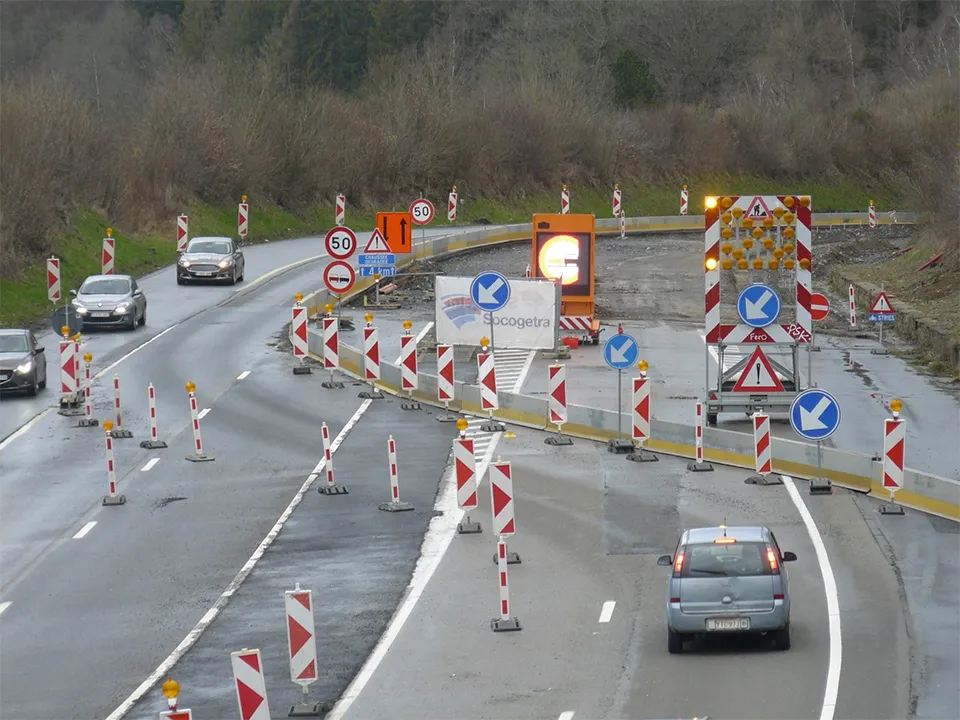
To make roadworks more visible, the condition and positioning of signage will be inspected daily following any weather event that could disrupt or damage it, such as a storm, thunderstorm or snowfall. Impact protection vehicles will also become mandatory on motorways and similar roads. In addition, any lane reduction must be marked by synchronised flashing lights. These will create the equivalent of a luminous kerb, making the roadworks more visible to road users.
Keeping traffic flowing
In built-up areas, outside working hours, particularly in the evening and at weekends, and whenever work is suspended for a specified period, signs that are no longer needed must be fully covered or removed. On motorways, the speed limit is now 90 km/h at short-term worksites.
Sharing the road considerately
For roadworks covering more than 2 km, signs indicating the number of kilometres remaining will become standard. Traffic lights will also have to indicate how much time remains in the current phase. In both cases, these measures provide road users with better information and help make their journeys more relaxed.
The new decree came into force on 1 March 2021. It repeals, in the Walloon Region, the ministerial decree of 7 May 1999 on signage for roadworks and obstacles on public roads. The new rules apply to all worksites on regional and municipal roads, including utility works by companies such as Proximus, SWDE and ORES.
Question about this story? Ask your question
Keep following this
Get an email when a new story is published. No account needed.
- SubjectNews







