











Natural grass: a highly sustainable insulation material made in Wallonia
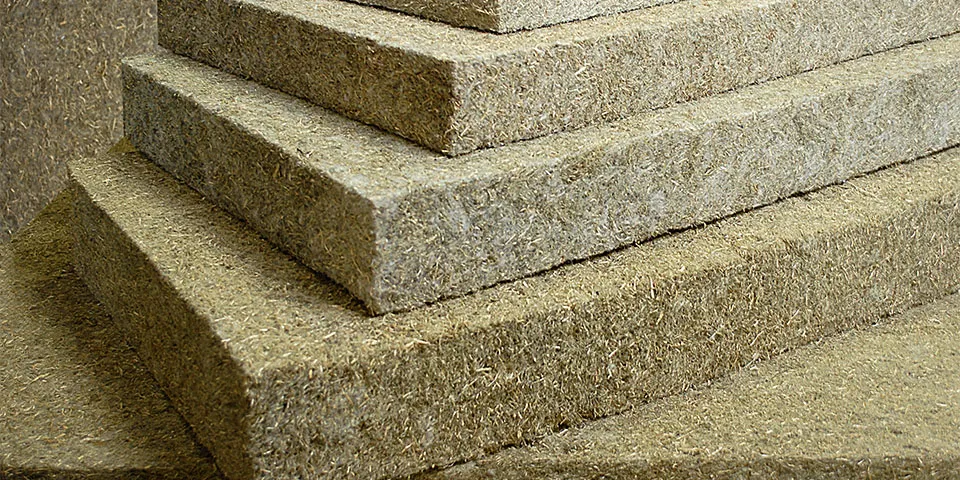
Insulating with grass? It may sound surprising at first. Yet this product is a serious, high-performance insulation material. Discover Gramitherm panels, which benefit the local economy and the environment.
The story began 5 years ago. Christian Roggeman bought the Swiss Gramitherm technology patent, for a bio-based insulation material made from natural grass fibres. He then founded Gramitherm Europe, which opened its very first production plant in Auvelais, Wallonia, last December. The plant has an annual capacity of 120,000 m3 of panels. “2 years ago, we approached the Cluster Eco-construction, which highlighted Wallonia’s advantages in terms of location, networks and installation capacity, and opened several doors for us so that this industrial facility could be up and running in record time,” explains Christian Roggeman, CEO of Gramitherm.
Why grass?
First, grass is an abundant resource, available in large quantities in many parts of the world. It also grows back quickly after being cut, making it a rapidly renewable resource. Finally, as it grows, grass stores significant amounts of CO2. What is more, the panel manufacturing process recovers grass juice, which will eventually be processed and used as biogas. Its energy will be used to dry and process the grass fibres. Thanks to this “smart” process, the grass itself supplies the energy needed to turn it into insulation. The result is a drastic reduction in CO2 emissions: in total, producing 1 kg of insulation material allows the equivalent of 1.5 kg of CO2 to be stored long term!
Cutting-edge performance
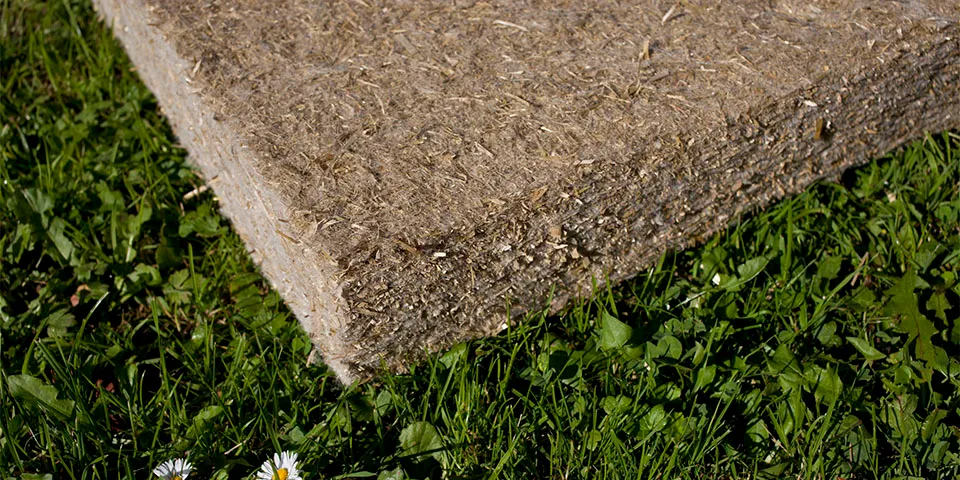
Gramitherm provides good insulation against the cold. Its thermal conductivity, or lambda value, of 0.040 is comparable to that of other insulation materials on the market. Its protection against heat is more unusual and worth noting, with a time lag of 11 h (at a thickness of 200 mm). Like many bio-based insulation materials, Gramitherm panels also help regulate humidity by absorbing excess moisture. Finally, the panels’ complex structure makes them effective at absorbing sound. In terms of safety, they do not ignite or release toxic fumes. They resist fungi, do not attract rodents because they contain no food, and do not cause allergies. They are also easy to work with and non-irritant. Extensive testing, including the European Technical Assessment (ETA) received by Gramitherm, has shown that the panels retain their dimensions over time, while their flexibility makes them easier to install. They can also be readily recycled, and their service life is estimated at more than 50 years. Christian Roggeman, CEO of Gramitherm, agrees: “The first panels installed in Switzerland 10 years ago were recently monitored: none had moved, either physically or in terms of their characteristics. This proves the product’s quality and long-term durability!”
Local supply chain
For now, Gramitherm panels are made from grass not used as animal fodder, sourced from the polders in Flanders and the Netherlands. “But discussions are under way in the region about using new sources, such as grass cuttings from Charleroi Airport,” says Christian Roggeman. “Hundreds of tonnes of grass are cut and end up as waste, even though they could be put to good use by us.” This would further strengthen the project’s local supply chain, with quality at its heart at every level.
Question about this story? Ask your question
Keep following this
Get an email when a new story is published. No account needed.
- SubjectNews







