











Namur, Wallonia’s capital of sustainable mobility
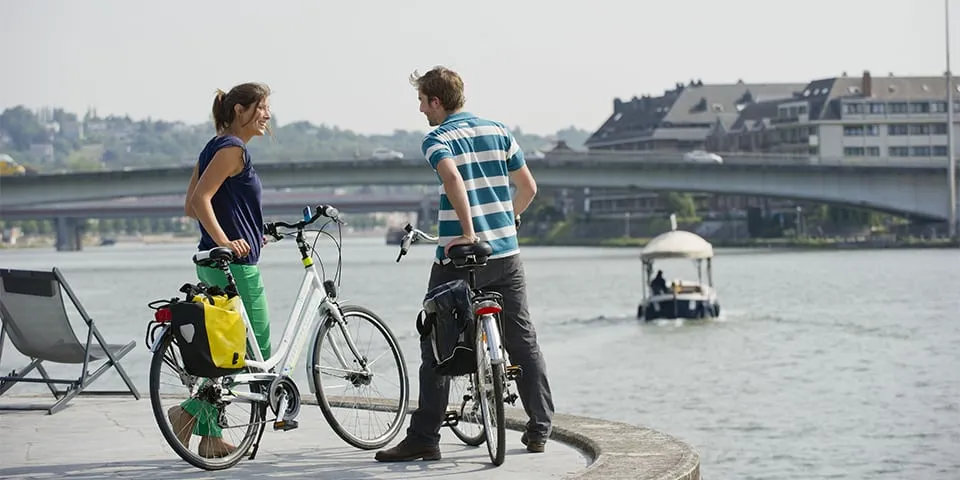
Faced with congestion and air quality problems in Namur’s “corbeille” district, local authorities have long been at the forefront of sustainable mobility in Wallonia. By soon putting an Intelligent Transport System (ITS, see article on pages 18-21) into service, the City of Namur aims to offer residents and visitors a range of mobility options made up of different modes of transport. This will be a first for Wallonia, and possibly for Belgium. Construire la Wallonie spoke to Michel Jehaes and Bérénice Ruyssen, the driving forces behind the project at municipal level.

Namur was the first city in Wallonia to offer bicycles through a bike-sharing scheme. (Photo: Ville de Namur)
By the late 1990s, Namur was already at the forefront of mobility planning, with one of the first Municipal Mobility Plans in Wallonia, as well as a parking plan and traffic loops in the city centre. Michel Jehaes, Head of Department, Public Roads Department, City of Namur: “We realised then that planning mobility was not enough: we also needed to work with spatial planning to factor in the mobility pressures resulting from urban development. Infrastructure has a limited capacity, so space needs to be shared more. That makes it essential to provide users with better information.” In parallel, under the impetus of Mayor Maxime Prévot, the ambition to make Namur a Smart City took shape. The ERDF call for projects (2014-2020 programming period) was the catalyst. We submitted an ITS project, which at the time was still fairly general. We then visited cities such as Lyon and Ghent, which already had similar systems.”
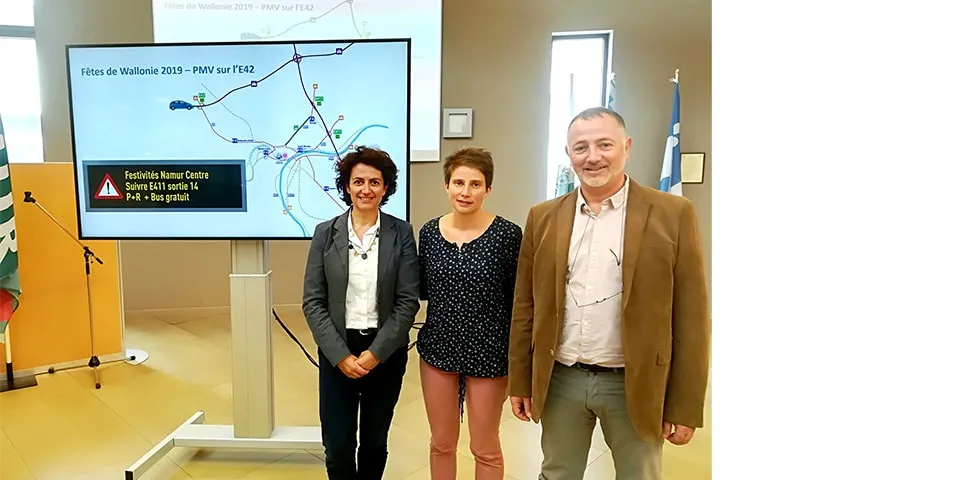
Patricia Grandchamps, Alderman for Mobility at the City of Namur, Bérénice Ruyssen and Michel Jehaes.
Multimodality and public control
Michel Jehaes: “We wanted to go beyond simply connecting road traffic and offer a multimodal approach. Another key feature of our project is that the underlying data is controlled by the public authorities and made available to the public. This is why we opted for ANPR cameras rather than data from third parties. And instead of developing our own application to bring this data together, we decided to make the information available as open data, so that specialist operators could use it. This also means we avoid entering into an exclusive arrangement with one of the major operators. Even a start-up or a small independent operator will be able to use the data. The ITS project will deliver a website displaying information on a map of Namur, not a journey planner.”
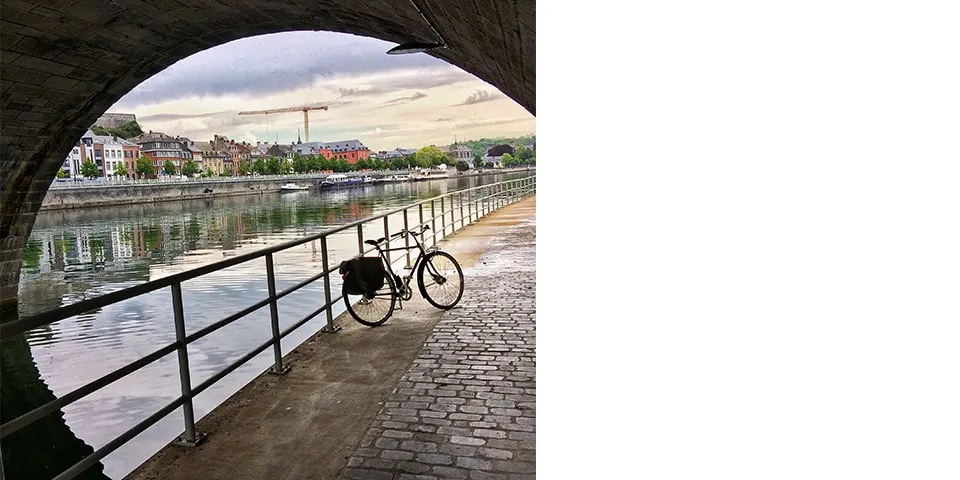
Cycling plays a key role in the City of Namur’s mobility plans. (Photo: Ville de Namur)
Infrastructure for a different kind of mobility
Of course, for an Intelligent Transport System that promotes multimodality to work, it needs to be backed by infrastructure offering credible alternatives to car journeys: P+R car parks on the main routes into the corbeille, an efficient bus network, and shared vehicles, including bicycles and cars, among other options. Namur is continuing the work already well under way. The P+R Saint-Nicolas, currently the only one of its kind, will soon be joined by several others, strategically located at the city’s entrances, near motorway exits or other major routes. The P+R de Bouge is the most advanced. Another is then expected to be developed at Erpent. Belgrade and Salzinnes are also being considered, but at a later stage. These P+R sites will allow people to leave their cars there and reach the city centre by another mode of transport, including the bus.
Bérénice Ruyssen, ITS Project Manager in the Public Roads Department of the City of Namur: “On the Chaussée de Louvain, which links the P+R de Bouge to the city centre, buses will run in a dedicated lane. A permit has been issued to create a central bus lane, shared by buses travelling uphill or downhill depending on the time of day. This will not reduce capacity for cars.”
In recent years, the City of Namur has been building a number of multi-storey car parks in the city centre. At the Grognon, Place du palais de Justice and on the site of the Casernes, among other locations, future car parks will be built underground, allowing high-quality public spaces to be created above ground.
Cycling has not been overlooked. Bérénice Ruyssen, a daily cyclist: “We are working, among other things, on the urban greenway that will link Namur station to Jambes station. Namur lies at the junction of 3 RAVeL routes, and this greenway will connect them. The new footbridge across the Meuse will link the quieter neighbourhoods of Jambes to Namur city centre via the Grognon. The entire city centre has been a 30 km/h zone for years, making it possible to cycle with confidence without always needing a segregated cycle path. Namur was also the first city in Wallonia to offer bicycles through a bike-sharing scheme. Li Bia Vélo has 240 bicycles available for trips to and from 26 stations across the corbeille and beyond.”
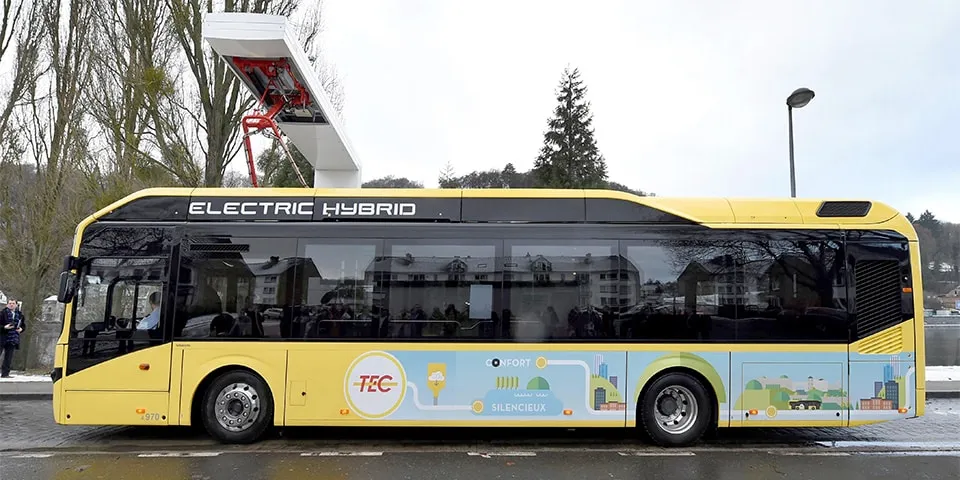
In the city centre, hybrid buses run in electric mode to protect air quality. (Photo: Groupe TEC)
ITS: sharing, information and adaptability
In Namur, it is not only bicycles and cars (through Cambio) that are shared. In a city centre where space is limited, there is also much discussion of shared use of on-street parking spaces. Bénédicte Ruyssen: “The parking spaces to be fitted with sensors have yet to be decided. These could help manage specific spaces more effectively: spaces for people with reduced mobility, bays reserved for deliveries until 11 am, spaces temporarily blocked for roadworks or removals, and so on. Here too, the ITS will be able to provide users with real-time information.”
As well as providing information to users via variable-message signs and a website (see article on pages 18-21), the ITS will be very useful to Namur’s mobility managers from the outset, as they acknowledge that they lack the on-the-ground information needed to improve their strategies.
It will be necessary to wait until the ITS goes live, scheduled for September 2019, to see it in action. It should help people in Namur breathe more easily, both literally and figuratively. Greenpeace recently singled out Namur as one of the cities with the highest measured nitrogen dioxide levels, despite the fact that hybrid buses have been running in electric mode in the city centre for a year. Air quality will also be monitored using sensors, with the data made public through the ITS. But the project has already been recognised by the SPW, which awarded it the prize for the most innovative public procurement contract.
Michel Jehaes is already looking further ahead: “Building on the ITS, we will be able to connect all this information with users’ needs. The concept of an ITS is giving way to that of connected mobility services. The idea is no longer to own a vehicle, but to have access to the mode of transport best suited to the situation each time, using a simple smart card. We are already positioning ourselves for this transition.”
Question about this story? Ask your question
Keep following this
Get an email when a new story is published. No account needed.
- SubjectNews







