











Lighting Plan 4.0 continues to pursue a sustainable approach that respects biodiversity
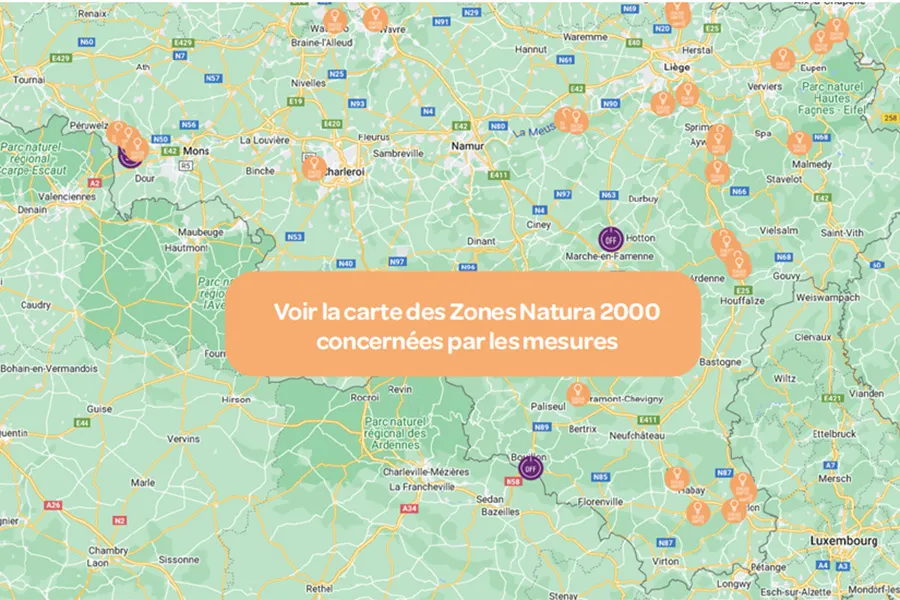
Since 01 April, ALL the measures set out in Lighting Plan 4.0 to preserve fauna and flora in Natura 2000 sites have been implemented on Wallonia’s strategic road network. In addition to lowering the height of the poles, using a less harmful colour temperature and choosing luminaires that direct the light towards the road, lighting dimming and even switch-off schedules are now in force in the most sensitive Natura 2000 sites. All these measures were developed on the basis of an Appropriate Assessment of Impacts carried out by ULg.
As part of Lighting Plan 4.0, Groupement LuWa and SOFICO have undertaken to implement a series of measures to respect the nocturnal cycle of fauna and flora in Natura 2000 sites. Accordingly, based on an Appropriate Assessment of Impacts by the Ecology Department of the University of Liège, Groupement LuWa approved the following measures:
Lowering the height of the masts:
Reducing the height of lighting poles near ecoducts makes it possible to direct light more effectively and thus limit the illuminated area as much as possible, disturbing the surrounding fauna and flora as little as possible.
Using less harmful colour temperatures:
Luminaires with a warmer colour temperature are less harmful to chiropterans, for example bats, and less disruptive to many species near sensitive areas.
“Just over 3,000 luminaires are affected by this change in colour temperature,” says Bertrand Vanden Abeele, LuWa Managing Director
Choosing luminaires with a 0% ULOR:
Luminaires with a zero ULOR, meaning they do not emit light above the horizontal plane, have been used across the entire network, not only in Natura 2000 sites. This makes it possible to maintain effective lighting on the roads, as the luminous flux is directed towards the road.
Reducing light intensity, or switching lighting off in highly sensitive areas:
Reducing lighting intensity, or switching it off, between 22h and 06h during the breeding season, from April to October, is the most far-reaching measure in Lighting Plan 4.0 to benefit biodiversity.
“This measure, which came into force on 01 April, provides a practical local solution for reducing the impact of light on fauna and flora without compromising road-user safety,” adds Bertrand Vanden Abeele.
“1,000 light points are affected by the switch-off, all of them on national roads. Signs will also be installed during May at the entrances to Natura 2000 sites to inform road users,” explains Héloïse Winandy, SOFICO Spokesperson
These measures help limit the impact of light on the biodiversity found in Natura 2000 sites on the strategic network, as different faunal groups do not respond in the same way when exposed to artificial light at night.
“Anuran amphibians, such as toads, frogs and tree frogs, are attracted to all lamps, whereas salamanders and newts avoid them. Some chiropterans, or bats, do not like lamps, particularly those that emit UV light, while other species tolerate luminaires and use them to hunt nearby. Insects are strongly attracted to blue and ultraviolet light, whereas birds can be drawn to warm, powerful lights with long wavelengths, especially during migration,” says Thierry Kervyn, biologist at the Department for the Study of the Natural and Agricultural Environment of the Walloon Public Service.
A map showing the areas covered by the measures introduced in Natura 2000 sites is available.
“Natura 2000 sites are protected natural areas found throughout Europe and governed by two European directives. These sites cover 13 % of Wallonia and 195 kms of roads pass through them. It was therefore important to introduce measures as part of the modernisation of the lighting,” explains Thierry Kervyn. All these measures were established on the basis of an Appropriate Assessment of Impacts by the aCREA consultancy at the University of Liège, drawing on studies carried out
previously by the SPW and adding recommendations on the protection of sensitive areas.
“It is important to limit the impact of our activities on biodiversity. I am pleased that Lighting Plan 4.0 is bringing smart lighting solutions to our Natura 2000 sites, which now shine with responsible lighting that respects the fragile ecosystems around them,” says Philippe Henry, Vice-President and Minister for Climate, Energy, Mobility and Infrastructure.
About Lighting Plan 4.0
Lighting Plan 4.0 is a project delivered as a Public-Private Partnership (PPP) between Groupement LuWa (Luminus Cities, CFE, Luminus and DIF) and SOFICO, with support from its technical partner, SPW Mobilité et Infrastructure. This 20-year partnership covers the design, modernisation and maintenance of public lighting equipment along the 2.700 km of SOFICO’s strategic network. To date, more than 90,000 light points, covering 2.500 km of the network, have already been modernised with dynamic, smart LED luminaires. These are managed remotely via a supervision platform connected to all the IoT equipment (the interconnection between the Internet and objects). The aim of the plan is to replace the 110 .00 light points originally powered by sodium lamps and save 76% of energy.
Question about this story? Ask your question
Keep following this
Get an email when a new story is published. No account needed.
- SubjectNews







