











“Insulation is becoming a professional trade”
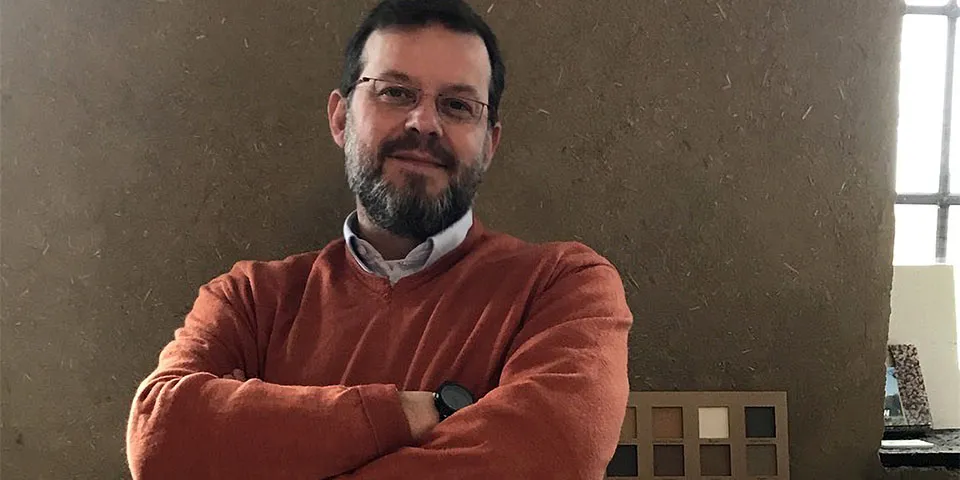
Laurent Ruidant is the new president of the Plateforme wallonne de l’Isolation, which brings together insulation professionals. He succeeds Dominique Bonsang. At the end of last year, we took the opportunity to meet him and discuss the platform during a visit to OTRA, the company he runs. Interview.
Laurent Ruidant, you are the new president of the Plateforme wallonne de l’Isolation. Why did you accept the role?
Because I believe it is important for clients to receive high-quality work, carried out by a professional using the right methods. It is also important to raise the profile of insulation as a trade.
Do you think it is not valued enough yet?
From time to time, we come across defects on site caused by a lack of knowledge or a poor understanding of the building. This is because the analysis and work carried out by the person who installed the insulation were inadequate. It is important to know that there are professionals who can provide good insulation and prevent damage. This is not a trade you can simply improvise. You need to understand dew points, moisture risks, the choice of materials and airtightness, among other things, to ensure the work is carried out correctly.
Why is it important to bring insulation professionals together?
The aim is to get everyone around the table to share their experience and knowledge. All platform members will have to work in line with a “quality charter”, which requires, among other things, strict project-monitoring procedures to guarantee the quality of the work. Finally, for those who see it as a time-consuming commitment, let me reassure them: they will only have four meetings a year.
How has the insulation trade changed in recent years?
I think that for quite a few years, people insulated homes with the best of intentions, but without necessarily carrying out the work properly. Insulation may also have been installed to qualify for grants. Now we have professionals who can consider the issues and put forward coherent solutions. The change is professionalisation: insulation is becoming a professional trade. Insulation is also increasingly included in construction courses.
What will you try to put in place during your term?
Work has been under way for three years to build momentum, and we are now moving into a phase of implementation and development. The charter has just been finalised, and insulation contractors will have to sign up to it and follow it. We hope to introduce a quality label, managed by an independent inspection body, in early 2021. Policymakers will need to support and endorse the initiative. We are also developing a website that will direct clients to companies specialising in particular types of insulation. Alongside these projects, we will need to bring together as many companies as possible that can guarantee quality for clients.
The energy renovation of buildings will be crucial in the years ahead, with very stringent political requirements. Good insulation could be the answer.
The political drive is to insulate as many homes as possible to save energy. But real energy savings can only be calculated if the insulation is properly installed.
If someone insulates their home badly, they will have spent money without saving energy. On the contrary, poor airtightness, for example, can cause a building to rot. It is important to realise that buildings can rot as a result of poor insulation.
During the presentation of your company, we noticed that you favour bio-based materials: hemp, lime, rice straw, and so on. Are these materials the future of insulation? Are they not too expensive?
Some people may indeed find them a little more expensive. But they offer many advantages. They have very good thermal lag. In summer, they prevent buildings from overheating, while in winter they have the opposite effect, particularly in passive houses. Buildings can also breathe when these materials are used: they are not vapour-tight. They also regulate humidity very effectively and, finally, have a carbon footprint close to zero. I would like to stress one important point: everyone is welcome on the platform, whatever material they use. The only requirements are to comply with the rules and install it correctly, regardless of personal preference.
You have already mentioned insulation grants. There are many of them. Are they underused?
The platform will also have a role to play here, for both clients and the administration. The aim will be to make it easier to apply for grants through a labelled company and a PEB auditor. The label should make it easier to access grants. We know the system is still a little complicated, but the aim is to simplify things.
Collaboration between the platform and other federations is very important. How do you see it working?
Through good communication, plenty of meetings, conferences, trade fairs and company visits such as the one we made today. The aim is to increase contact and collaboration, and ensure that the platform’s work is aligned with initiatives by other federations. CCW is helping us a great deal with this.
Any final words about your predecessor, Dominique Bonsang, the platform’s first president?
I am quite proud to succeed him. He was the driving force behind the platform and has been very involved, which takes a lot of time. He is still heavily involved, as a member of the management committee. He is a very pleasant and committed person, and, like me, neutral. He wants to represent everyone in the trade, whoever they may be. Thank you for all his work!
Question about this story? Ask your question
Keep following this
Get an email when a new story is published. No account needed.
- SubjectNews







