











In a Mega Tetris move, Infrabel carries out an operation never before seen in Europe
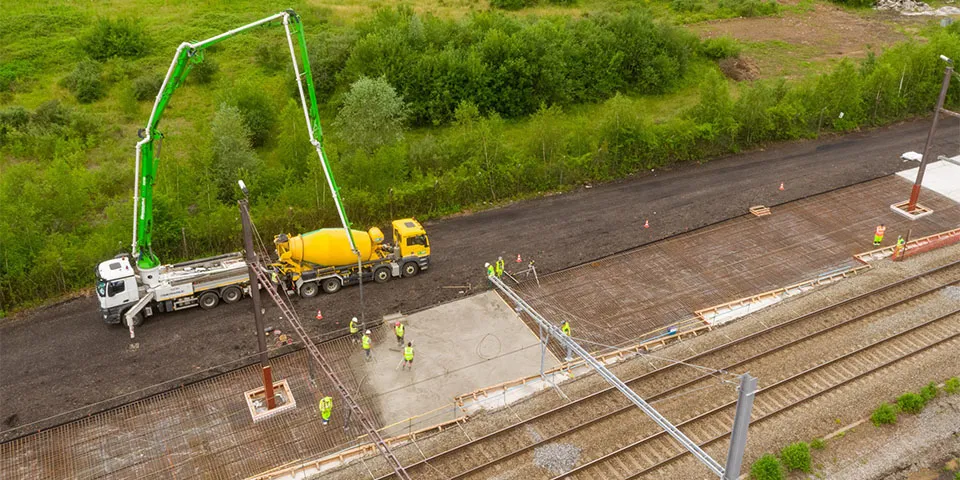
Renewing almost 1 km of track and replacing 4 sets of points at the same time would normally cause several weeks of disruption to rail services, to a greater or lesser extent. To minimise the impact on customers, Infrabel engineers are testing an innovative technique this weekend. A “block of railway infrastructure” has been pre-assembled on a mobile concrete slab, right next to the tracks in service. This Saturday, this piece in a Mega Tetris game, weighing as much as 18 fully laden long-haul aircraft, will be pushed into its final position, allowing services to resume much sooner.
A 6,100-tonne, 480-metre-long “block of railway infrastructure” is to be positioned on the line linking Namur and Charleroi

A weight equivalent to 18 fully laden long-haul aircraft
Work began in early May alongside the Walloon backbone (line 130), close to Franière halt. Infrabel teams first built a slab on the site of a former goods yard, using 1,300 m³ of concrete and 300 tonnes of reinforcement steel. The structure is “XXL” in size: 480 m long, 8 m wide and around 30 cm thick. It was then fitted with 2 x 480 m of track, ballast (the layer of crushed stone) and 4 sets of points. The result? A ready-to-use “Tetris block of railway infrastructure”.
The second phase of the work is taking place on 5 and 6 September: this giant structure must be pushed into its final position, a distance of around 16 metres. It is a challenge to move a structure weighing 6,100 tonnes, the equivalent of 18 fully laden long-haul aircraft!
Never before seen in Europe
The technique developed by Infrabel engineers is a first: nowhere in Europe has a section of infrastructure, or even a railway structure, of this length ever been pushed into position!
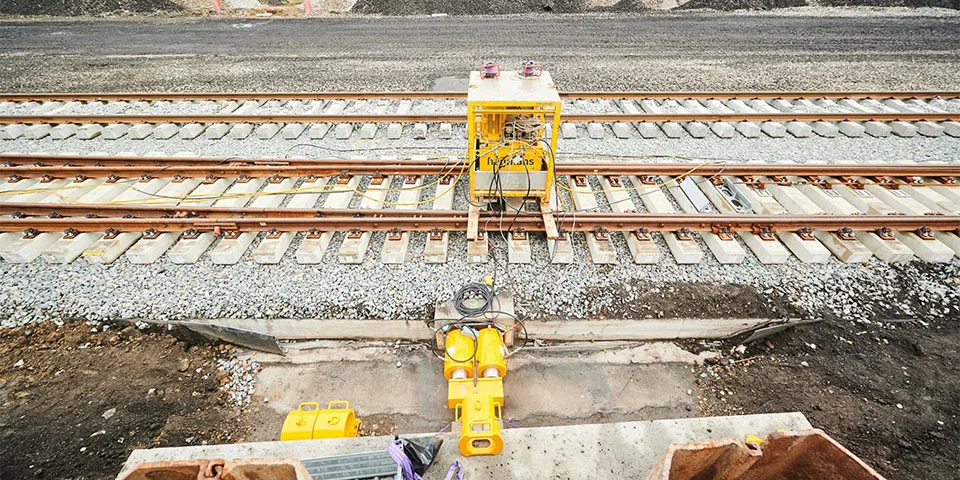
Taking advantage of an exceptional closure of the line between Tamines and Namur, around 100 workers, assisted by a dozen machines and cranes, began operations late on Friday evening. They first dismantled the existing infrastructure, which had reached the end of its service life. Removing the rails, ballast and railway sleepers made way for the installation of the new section of infrastructure. To move this colossal mass, the technicians built thrust blocks, with foundations 3 metres deep, against which 16 jacks are positioned, spread from one end of the slab to the other. The pushing operation will take around ten hours, at a maximum speed of 1 m per hour.
Once this operation is complete, a few welds on either side will be needed to connect the new section to the existing tracks. Services can resume on Tuesday morning, after around 70 hours. In addition, the curve on this section of line will have been redesigned. In the longer term, trains will therefore be able to travel at 120 km/h instead of 100 km/h, as in the previous configuration.
Major benefits for customers
With a traditional approach, when railway infrastructure needs to be renewed, Infrabel teams work at night or take the track out of service. All trains then take turns using the only track still available, which can cause disruption and delays of varying severity. On a line such as the Walloon backbone, a project of this kind could affect 135 passenger trains and around 40 freight trains.
The innovation deployed on the Namur-Charleroi line is primarily a way of limiting the impact of works on rail services. For Infrabel, the investment, which will amount to around €4 million, is broadly equivalent to the cost of a traditional approach. But the benefits for customers, and the fact that the work takes place away from tracks in service, improving worker safety, are a real bonus!
In practical terms, pre-building this mobile slab has made it possible to:
- Limit the use of “single-track working” to 18 days (and 3 weekends), compared with 49 days (and 8 weekends) using a traditional approach;
- Limit the total closure of rail services to 3 weekends (compared with 5);
- Cut by a factor of 4 the time for which a “post-works” speed restriction is in force
An innovation that cannot be rolled out everywhere
This European first will be evaluated, but given its benefits, it is already clear that the approach will be used on other projects. Infrabel is already assessing whether it could be used for two infrastructure renewal projects on the “Athus-Meuse” freight route (which links Antwerp to the Luxembourg border).
Unfortunately, this innovation cannot be applied to every project. It requires sufficient space alongside the tracks, with access for the delivery of materials.
Question about this story? Ask your question
Keep following this
Get an email when a new story is published. No account needed.
- ThemeTransforming infrastructure and territories
- SubjectNews







