











Hydrogen strategy presentation
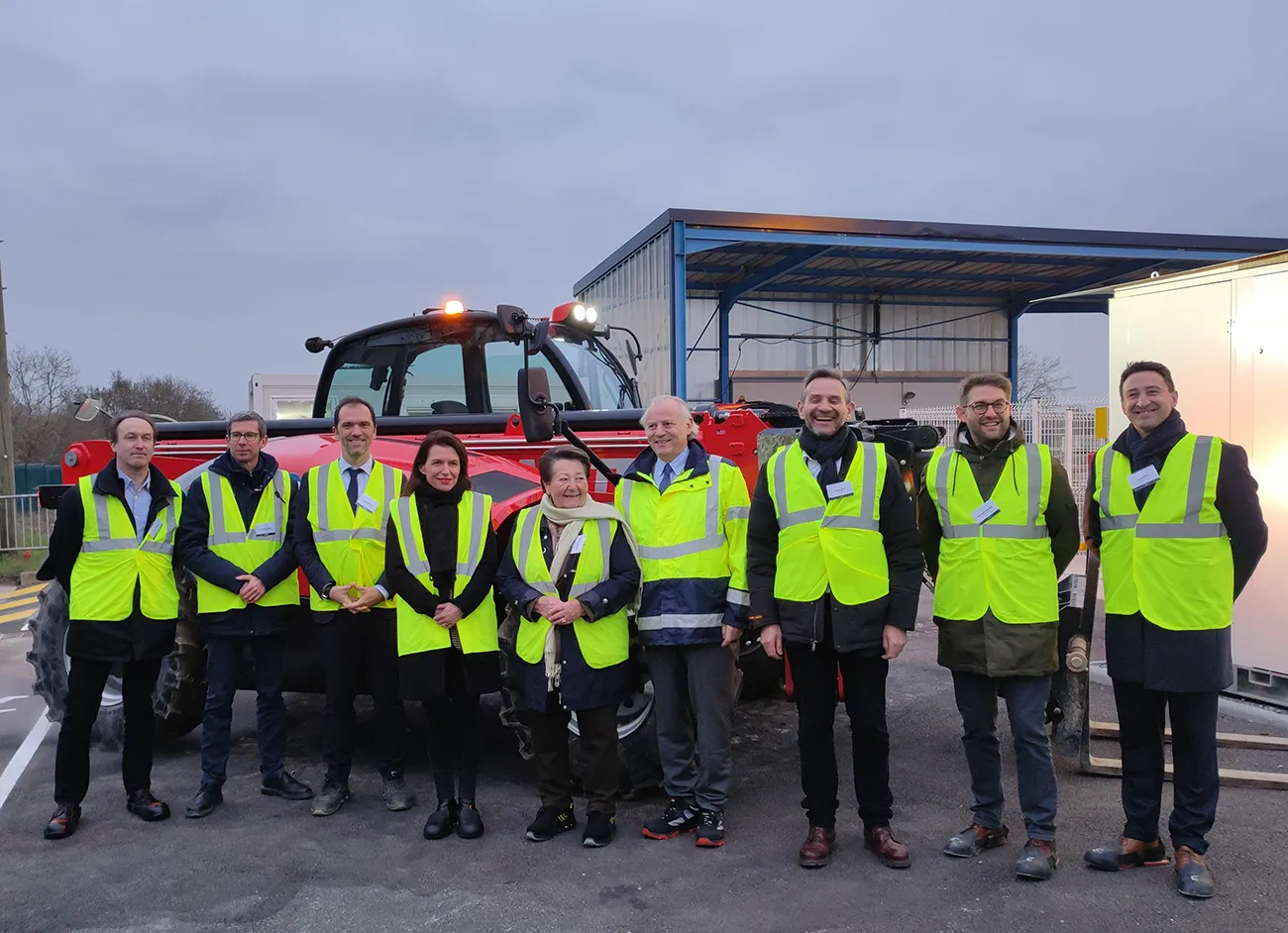
Manitou Group, a global leader in material handling, access equipment and earthmoving, presents its R&D roadmap for hydrogen-powered machines. The opportunity to unveil the first innovative prototype of a telehandler powered by green hydrogen.
The energy transition is accelerating
With a target of reducing greenhouse gas emissions per hour of machine use by 34% by 2030, Manitou Group has set itself an ambitious goal, in line with the commitments in its low-carbon roadmap, announced in January 2022 and validated by the SBTi last July. Having recently electrified its ranges of rough-terrain access platforms and telehandlers, the group is also turning to hydrogen to offer users other alternatives in the medium term. Manitou Group aims to offer electric and hydrogen-powered ranges side by side, depending on each user’s applications, with a target of 43% of products sold in 2030 being low-emission.
A development plan dedicated entirely to hydrogen
In front of a large gathering of journalists and elected representatives, Manitou Group presented its new facilities for carrying out its hydrogen development plan. By equipping its test centre with a green hydrogen station, the group has the resources it needs to test its brand-new telehandler prototype. The first stage of the plan is to ensure that the machine offers the required operating range and reliability in real-world conditions, while testing the durability of its components. For this first prototype, the group used an existing model from its range of construction machines, capable of lifting loads to a height of 14 m. The machine will be tested and made available on construction sites at the end of 2023, providing valuable user feedback to help refine the prototype. The market is currently assessing two types of hydrogen technology: the internal combustion engine and the fuel cell. The group’s first prototype is based on a fuel cell, but the group will choose the hydrogen solutions best suited to its customers’ needs. Manitou Group CEO Michel Denis explains the approach: “We are studying all hydrogen-related technologies, focusing above all on users’ needs. This prototype is only a first step. A second prototype, a rotating telehandler, will be developed in the coming months. Green hydrogen has many advantages, as it can be produced using wind power without any greenhouse gas emissions. This fits perfectly with our low-carbon roadmap.”
With this first prototype, the group is highlighting its capacity for innovation, measuring the operating range of this new energy source while offering its customers the hydrogen solution best suited to their needs, with no compromise on performance. Nearly 50 engineers and technicians are dedicated to this initiative, which began in 2021. To deliver an innovative solution that is fully ready for industrial production, the group hopes to count on support from public authorities to develop an ecosystem that is still in its infancy. Julien Waechter, VP R&D Manitou Group, explains: “The green hydrogen sector will gradually take shape as many new players enter the market. Support schemes offered by governments will all help drive the transition to hydrogen and accelerate the development of the distribution network, ultimately reducing the cost of operating our machines powered by this energy source.”.
With these new facilities, Manitou Group hopes to offer its customers new and innovative opportunities, with a 100% hydrogen-powered telehandler set to reach the market by 2026.
Innovation is in our DNA
With more than 350 engineers on its staff, Manitou Group is constantly innovating, offering users high-value-added solutions. To achieve this, the group invests nearly €60 million each year across its 10 R&D centres worldwide. Modernising its production facilities is also essential to maintaining this capacity for innovation. The recently announced €150 million investment plan for its production sites in the United States and France is proof of this. The latest access platform factory, inaugurated in 2022, is a good example of this commitment. Whether it is the choice of components, user comfort or the attachment fitted to the machine, innovation is everywhere. An autonomous order-picking robot, electric rough-terrain access platforms and 100% electric telehandlers are just some examples of practical innovation. To support this progress, the group incorporates ambitious CSR criteria from the design stage, with the aim of developing increasingly sustainable and responsible machines.
Question about this story? Ask your question
Keep following this
Get an email when a new story is published. No account needed.
- ThemeConstruction machinery and equipment
- SubjectNews







