











Dry stone walls: new tools support companies and craftspeople
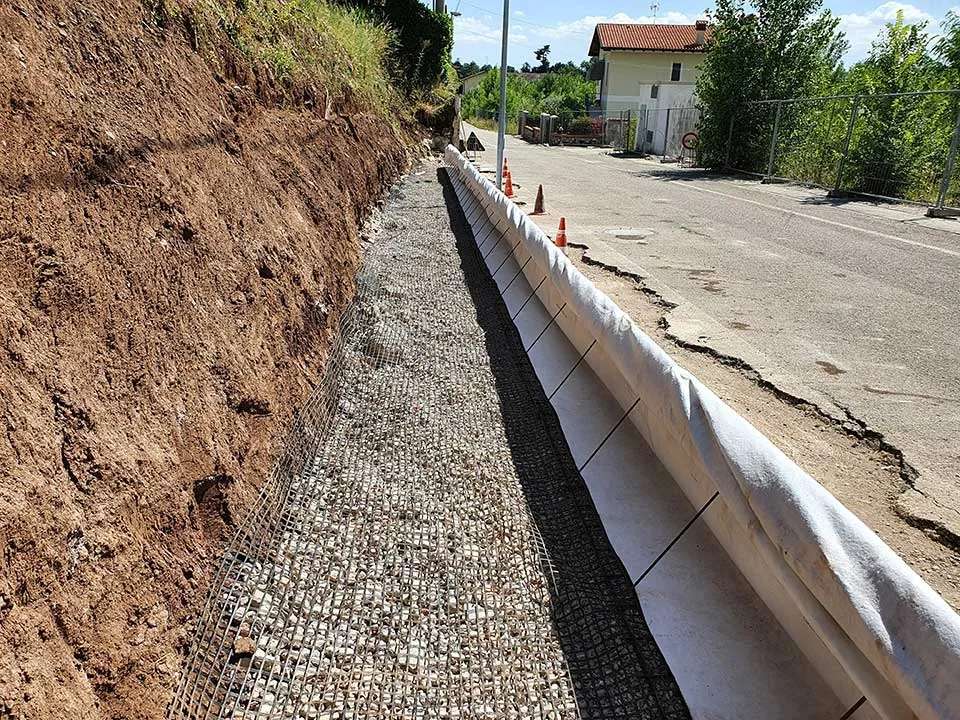
The ancient craft of dry stone walling and the newer naturalistic engineering technique of reinforced soil now have an ally that helps them work more efficiently.
UNESCO has also helped to recognise its value: at the end of 2017, the craft of dry stone walling was added to the List of Intangible Cultural Heritage in Need of Safeguarding.
The reasons for this recognition have deep roots: knowledge of the technique has been passed down through traditional rural communities to today’s professionals. The aim has always been the same: to prevent landslides and flooding, combat soil erosion and desertification, while fully respecting the environment. The inscription brings together eight European countries, each with different dry stone walling techniques, all carried out «by hand» or by laying stones on top of one another, without any other materials, except in some cases dry soil.
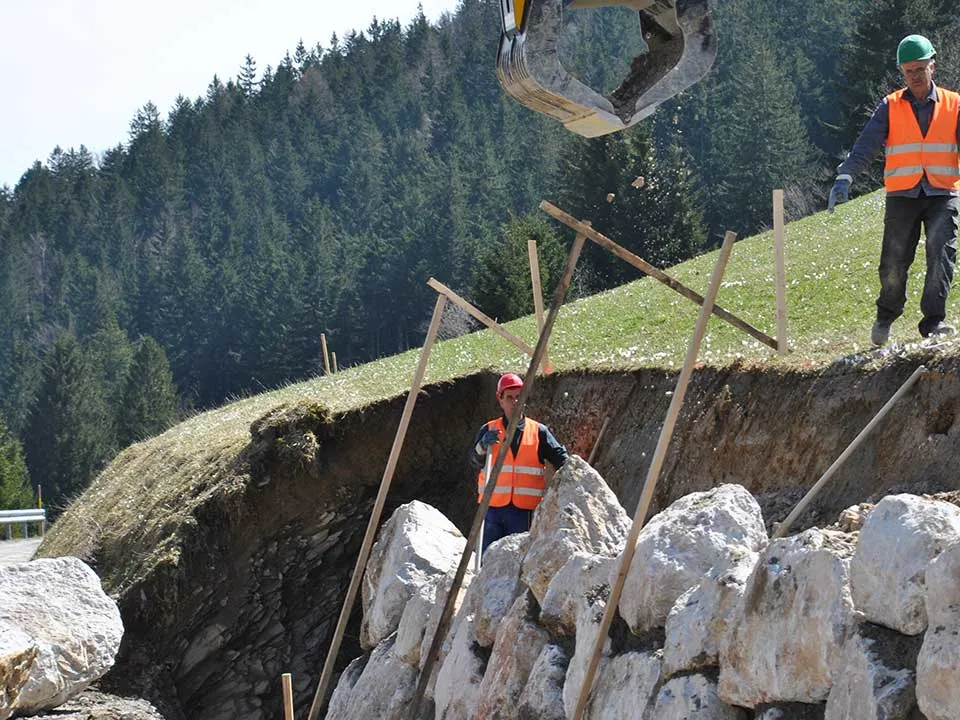
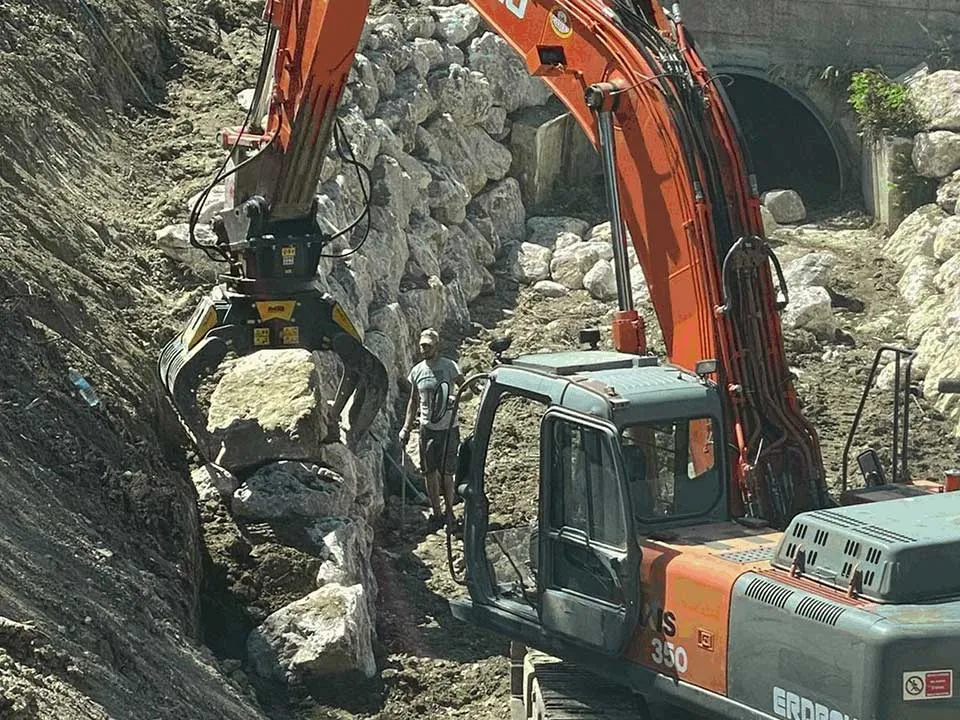
Over time, however, even the oldest techniques have supplemented the work of «craftspeople», a skilled workforce that is unfortunately disappearing, with new equipment capable of completing the work more quickly and ensuring maximum precision. One example is the MB-G sorting grabs, whose tines grip, move and place stones, rocks and stone blocks of all types and sizes with extreme precision and care. This was the case on three different construction sites, one in France, one in Germany and the other in Slovenia, where the MB grab was chosen to build dry stone walls precisely because its angled plate gave it a wider working range and allowed stones to be placed with extreme precision, unlike other equipment, such as an excavator bucket, which would have made this impossible. A tine kit can also be fitted to make it easier to grip and control materials with unusual weights and shapes.
For walls built using timber posts, operators also chose to work with MB Crusher products, in this case crusher and screening buckets. The reason is simple: by crushing and screening on site, waste can be recovered and immediately used as drainage material or general fill. This is what an Italian company did when rebuilding a collapsed retaining slope, using both MB tools: eliminating logistics costs, using local materials, building quickly and avoiding difficulties caused by the steep gradient of the embankment.
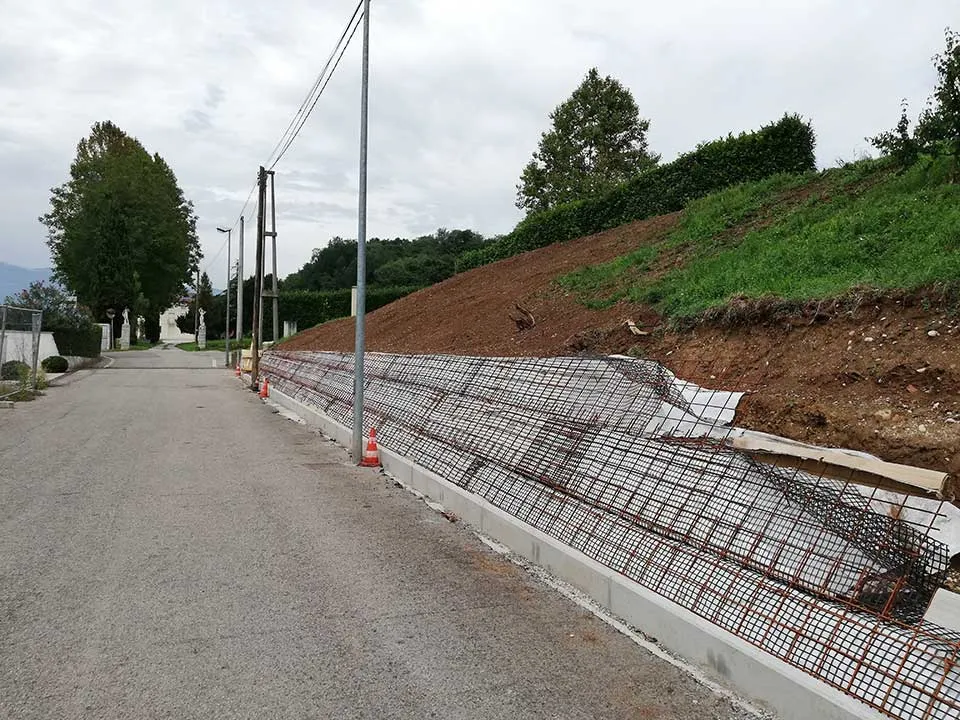
A modern evolution of dry stone walls is the new reinforced soil technique, a naturalistic engineering solution that makes it possible to replace concrete walls with structures that have a lower environmental impact. Like dry stone walls, this technique uses local fill materials, retains a natural appearance, is more flexible in response to ground movement, and is easy to install and maintain. One significant example is a Venetian company tasked with building a reinforced soil retaining wall to replace an existing concrete masonry wall. Sonia, the construction company’s geotechnical engineer, explains how they overcame the challenges of waste management and limited working space due to the mountain road’s gradient.
«To carry out this work, we relied on MB Crusher equipment for the crushing and screening stages. This allowed us to save on buying new materials by crushing stones recovered from screening the soil, which we would otherwise have had to dispose of at considerable cost, to obtain the stone we used for drainage. The screened soil, meanwhile, was immediately reused for placing inside the formwork. I would like to thank MB Crusher for the advice that helped us save time and money while respecting the environment.»
Isn’t it every company’s dream to have versatile, easy-to-use equipment in its fleet that enables it to work precisely and quickly while keeping costs down?
Question about this story? Ask your question
Companies in this story
Keep following this
Get an email when a new story is published. No account needed.
- SubjectNews
- CompanyMB Crusher







