











Crowdlending: the essential financing tool for property development
Heard of crowdlending? No? Then it’s high time we introduced you to this new way of financing, which is becoming increasingly popular in the property sector. The secret of its success can be summed up in one sentence: individuals lend directly to property developers.
This financing model is particularly well suited to the property sector. The reason is that it allows developers to allocate their equity across several projects. This leverage effect can deliver returns on equity up to twice as high. What’s more, it’s quick and easy. Interested?
François Jacquet, Head of Real Estate at Look&Fin, explains how crowdlending works and why it has become essential when structuring property finance.
François, could you explain what crowdlending is?
“ Crowdlending enables businesses to borrow directly from individuals, more quickly and efficiently than through traditional banking channels. Crowdlending also fully digitises loan applications: businesses can log on to the crowdlending platform 24 hours a day (24/24), 7 days a week (7/7), and find out very quickly whether they are eligible. If the assessment of their ability to repay is positive, they raise the funds in an average of 15 days. Funds raised through crowdlending are also treated as quasi-equity, making it easier to secure additional bank loans and providing leverage with banks. “
Why is crowdlending particularly well suited to the property sector?
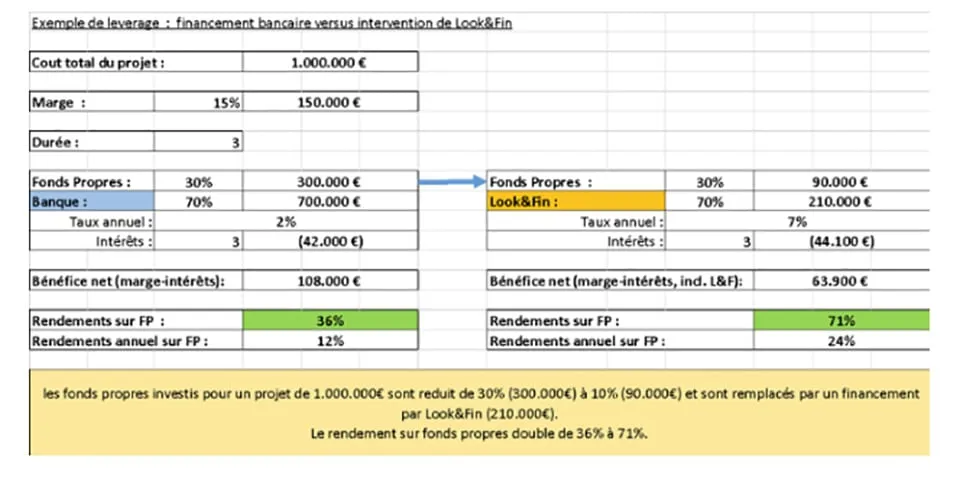
“ Structurally, property development is a highly capital-intensive activity that requires substantial equity. Banks generally agree to lend between 60 and 80% of the total cost of a property project, and that percentage is tending to fall. The balance comes partly from the developer’s equity and partly from the proceeds of off-plan sales. The key challenge for a property developer is precisely to obtain bank financing while preserving as much of their equity as possible. That is where crowdlending comes in. If you finance an investment of €1 million in the traditional way (30% equity, 70% through the bank), you can expect a return of around 36% after three years. However, if your equity represents only 10% of the required budget and you raise 20% through crowdlending, your return doubles, despite an average interest rate of 7%. The table alongside helps you understand how this works. “
So there are real double benefits, but at what cost?
“ The cost of borrowing for the developer generally ranges from 6% to 9% on the tranche structured through crowdlending. This rate is certainly higher than the rate offered by banks, but crowdlending finances mezzanine debt, which is, in principle, riskier. Furthermore, the weighted average cost across all the debt raised remains very low, and the increased return on equity more than compensates for the higher rate. “
If I need to contribute less equity, does that mean that, as a property professional, I can finance more projects?
“ Absolutely. By reducing your equity contribution per project, you can undertake more developments at the same time while achieving a higher return. “
What guarantees do I have to provide in return?
“ The bank requires a first-ranking mortgage over the land and buildings under construction, which is generally not the case for borrowing structured through crowdlending. Depending on the project, we may, for example, take a mortgage ranking after the bank’s. In every case, however, our eligibility criteria are fairly strict: the property group and its management must generally demonstrate solid experience in the sector, and the project’s budget, profitability and financing must all be viable. “
How much can you raise?
“ We are recognised by the FSMA, which allows us to finance up to €5 million in addition to bank financing and equity, but for now we limit ourselves to a maximum of €2 to €2.5 million per project. I won’t hide the fact that, given the growth we are experiencing, we aim to raise larger amounts in the future. That does not prevent us from financing smaller projects, starting at €250,000. We usually offer bullet loans over 24 to 36 months. In the first half of 2019, we raised no less than €7.8 million for property projects, and our total portfolio across all sectors currently stands at €70 million. “
Can I repay my loan early without charges?
“ Property projects do sometimes sell more quickly than expected. If that happens to you, there’s no problem. You can repay your loan early without charges.
How does the relationship between the developer and the platform work in practice?
“ We are indeed a platform, but behind it are property experts who assess applications and support developers in structuring their financing. Property is a highly specialised business, and we know it well. We offer loans tailored to each situation. However, once the funds have been raised and transferred, we do not act like a shareholder who has to be kept informed. We do not interfere in any way. Our sole concern is, of course, monitoring repayment of the loan instalments to our lending community. Your only point of contact is Look&Fin Finance, the financing vehicle through which the transactions are carried out. With complete transparency. “
Question about this story? Ask your question
Keep following this
Get an email when a new story is published. No account needed.
- SubjectNews







