











Creative solutions needed to widen the Lys
Work to widen the Lys is under way in Comines, led by the Walloon Region. It is part of a European project to link the Seine basin with Northern Europe by making the Lys navigable for vessels of up to 4400 t. For the dewatering work, the TRBA/Artes Depret joint venture called on G. Smeyers of Zandhoven.
The site lies between the Bas-Warneton lock and the Ipalle wastewater treatment plant, at the height of rue de l’Europe in Comines. “The work involves realigning the course of the Lys,” explains René Lambrechts, managing director of G. Smeyers. “This required us to excavate a construction pit approximately 6 m deep and 1000 m long, with a base 30 m wide and side slopes at a gradient of 12/4.”
Initially, the dewatering was to be carried out using vertical wellpoints along the edges, supplemented by horizontal drains in the centre of the pit. “However, the latter technique could not be used because of the presence of bombs dating from both world wars. In addition, clay was found at the surface over more than half of the pit, above a layer of highly permeable sand containing confined groundwater. Elsewhere in the pit, we encountered an accumulation of sand containing unconfined groundwater.”
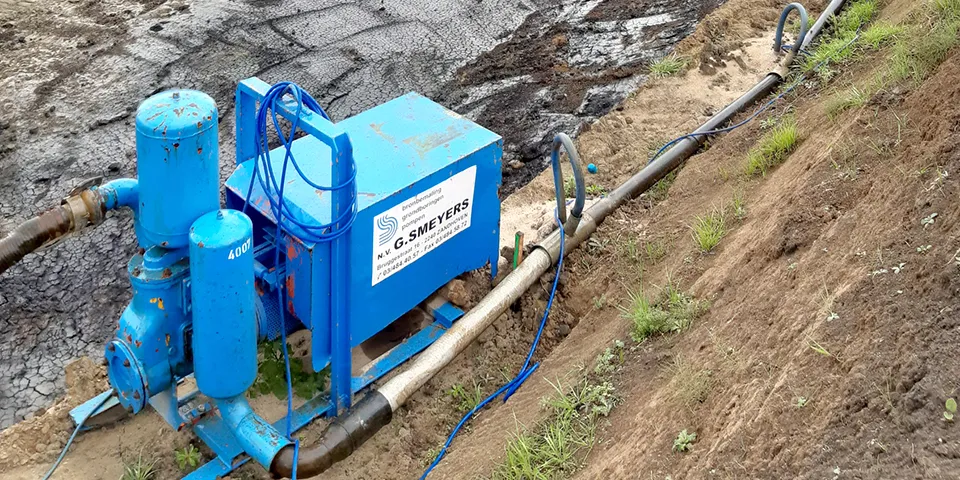
26 piston pumps discharge the pumped water into the Lys or into a ditch excavated by the contractors.
A bespoke dewatering plan was therefore devised. “In the area with confined groundwater, ten wellpoints were first installed and brought into operation, after which the contractors were able to excavate down to the planned level of the berm in the riprap slope. This allowed the riprap work on the slope to proceed without interference from the dewatering.”
“Following this preliminary excavation and a search for bombs, 500 vertical wellpoints were drilled to a depth of 10 m, spaced 3 to 10 m apart and fully embedded in permeable sand to ensure the wellpoints had good absorption capacity. They were connected to 26 piston pumps, which discharged the pumped water into the Lys or into a ditch excavated by the contractors.”
Dewatering work began in July and is due to be completed during November.
Question about this story? Ask your question
Keep following this
Get an email when a new story is published. No account needed.
- SubjectNews







