











Asphalt recycling: why every process must be compatible
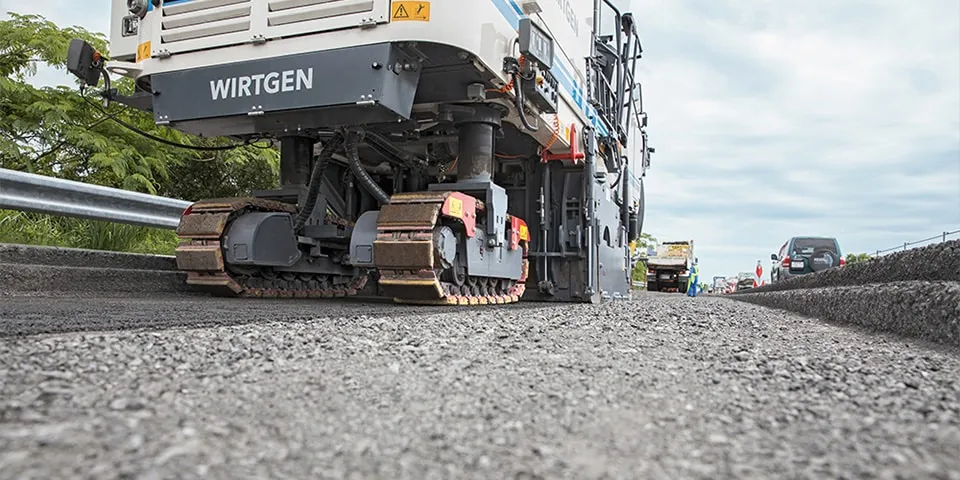
Producing construction asphalt from aggregates and bitumen requires a thermal mixing process, which in turn requires an asphalt mixing plant. Reclaimed asphalt is an increasingly important resource worldwide in the production of “black gold”. In addition, in industrialised countries, road rehabilitation has long outstripped new road construction.
And rehabilitation means milling millions of tonnes of asphalt. This work is carried out mainly by cold milling machines. They are the first link in the processing chain, followed by crushing and screening plants and asphalt mixing plants, and finally road pavers, which lay the new asphalt incorporating the reclaimed material. The efficiency of this process chain depends on the precise coordination of the machines and the use of innovative methods and modern technologies. Smooth operation at every stage improves the profitability and sustainability of asphalt recycling.
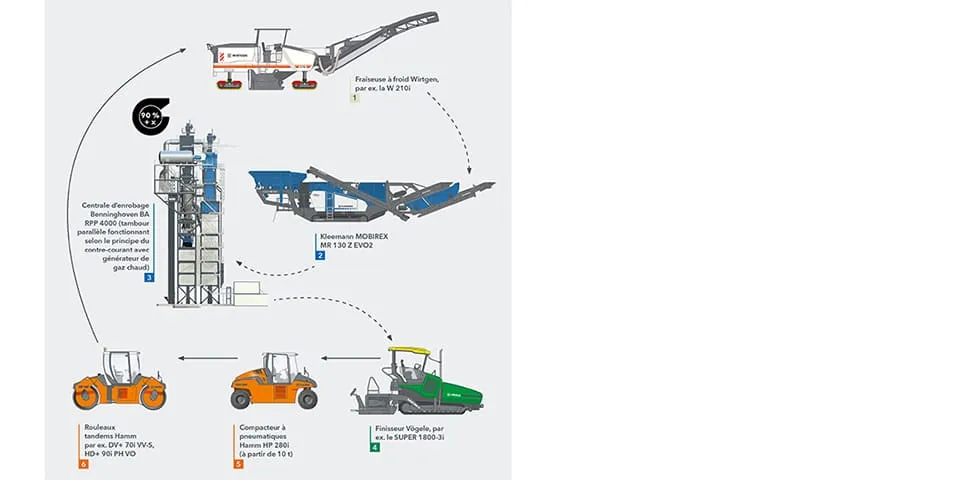
Complete solutions for asphalt recycling, from removing the old asphalt to reprocessing it, incorporating it into new asphalt and laying it. Optimising the production chain improves the profitability and sustainability of asphalt recycling.
The challenge: increasing the amount of recycled asphalt
In many countries, hardly any construction project goes ahead without using at least some recycled asphalt. In Germany, for example, a quarter of the asphalt produced in 2018, 41 million tonnes, was made from recycled asphalt, 10.5 million tonnes. With a total of 12 million tonnes of asphalt recycled last year, this represented a reuse rate of 87%.
Recycling asphalt for road rehabilitation is an economic and environmental imperative, helping to preserve natural resources. The industry is therefore constantly seeking ways to optimise processes at asphalt mixing plants. A key approach is to increase the amount of recycled asphalt used in all mix designs, with both hot and cold recycling technologies. Using the maximum possible proportion of recycled material benefits not only the environment, but also the price of the asphalt mix.
With the conventional parallel-flow recycling method, the temperature is limited to 130°C because of exhaust gas emissions. However, for physical reasons, the exhaust gases are hotter, leading to increased energy consumption and greater strain on the dust extraction system. To bring the asphalt mix to a temperature of 160°C, the virgin aggregate must then be superheated.
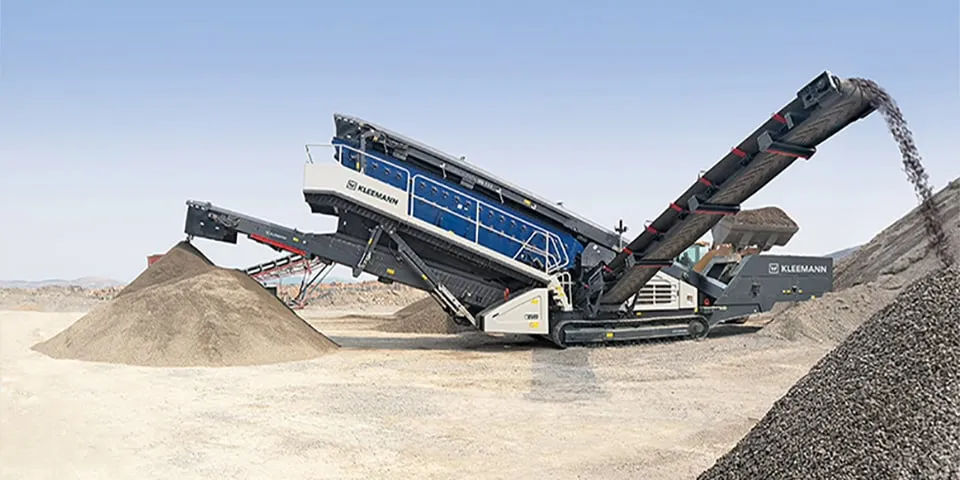
Screening plants such as the MOBISCREEN MS 953 EVO sort milled material to optimise the particle size distribution and thereby increase the proportion of recycled asphalt that can be added.
The solution: counterflow technology, a recycling rate of 90% + X
Unlike conventional parallel-flow recycling drums, recycling drums equipped with a hot gas generator heat reclaimed material indirectly using a counterflow process. The material moves through the drum in the opposite direction to the heat source. This process achieves higher material temperatures while reducing exhaust gas temperatures. The discharge temperature of 160°C matches the temperature required for subsequent processing, while the exhaust gas temperature remains above the dew point, at around 100°C. This is only possible with a hot gas generator, as direct heating would burn the reclaimed material and make it unusable. The burner in the bitumen unit, the hot gas generator, the recycling drum, the extraction hood and the air circulation and degassing system are all compatible. The benefit is that the virgin aggregate no longer needs to be superheated, resulting in significant energy savings. The counterflow principle can significantly reduce emissions in line with technical instructions on air quality and, depending on the quality of the reclaimed material, achieve recycling rates of 90% + X. This makes investing in this green, efficient technology even more attractive.
The process can be made even more environmentally friendly if upstream stages, namely optimising the particle size distribution and milling the asphalt, also use state-of-the-art methods and technologies.
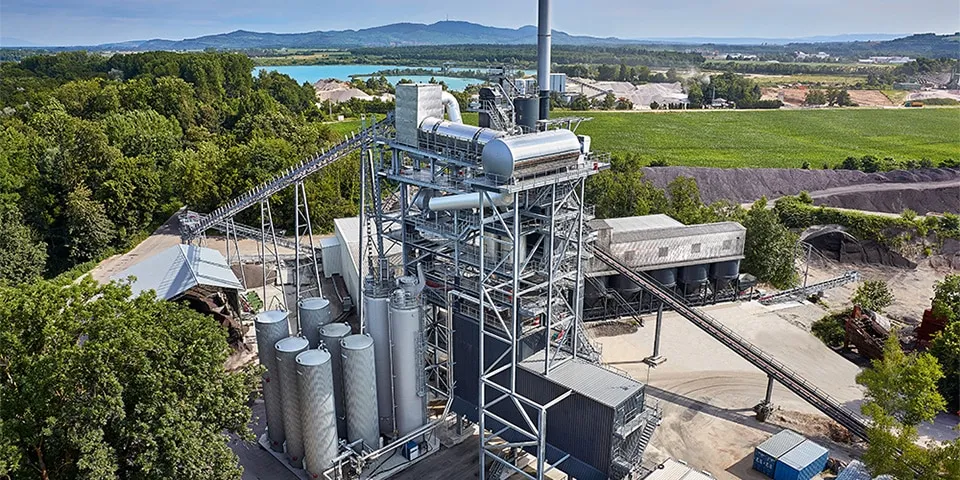
Asphalt mixing plants such as the stationary BA RPP 4000 produce up to 320 t of asphalt per hour. With a counterflow recycling process combined with a hot gas generator, the new asphalt mix can contain 300 t of recycled asphalt, equivalent to a recycling rate of 90% + X.
Screening plants: optimising particle size distribution to increase the proportion of reclaimed material
The maximum theoretical amount of recycled asphalt that can be used depends primarily on its particle size distribution, or, in other words, the quantities, sizes and composition of the materials it contains. The aim is therefore to bring the particle size distribution of the recycled asphalt as close as possible to that required for the final asphalt mix. This is where mobile screening plants come in. They allow up to 80% of recycled asphalt (milled material) to be reused immediately. This significantly cuts processing costs, which are far lower than those of fully reprocessing the milled material.
Full reprocessing, including oversized aggregates, would also require a crusher equipped with a secondary screen.
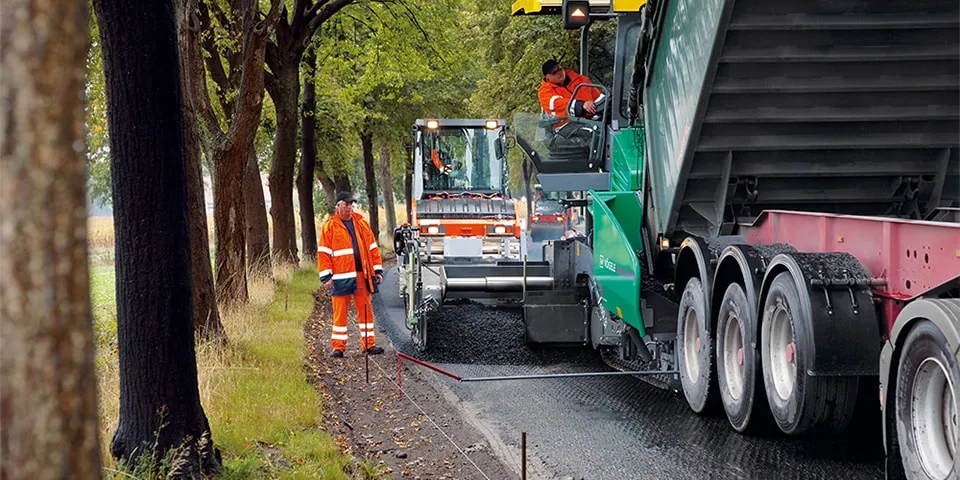
At the end of the process chain, pavers such as the SUPER 1800-3i and tandem rollers such as the HD+ 90i PH VO or DV+ 70i VV-S, as well as pneumatic-tyred rollers such as the HP 280i, lay and compact the recycled asphalt.
“Intelligent” milling: economical and environmentally friendly
It all starts with removing and recovering asphalt from the road structure. Cold milling machines remove the asphalt layer by layer, allowing the milled material, separated by asphalt mix type, to be returned to the materials cycle according to its suitability for construction applications and its quality properties. Selectively recovering the surface, binder and base courses alone offers clear environmental and economic benefits.
Using intelligent milling technology makes it even more economical to reuse the milled aggregates at the asphalt mixing plant. The load-dependent water spray system on cold milling machines plays a key role here. The water needed to cool the milling picks is regulated according to engine load and milling speed. Automatically activating the water circuit when the milling drum is positioned, or switching it off when milling stops, can reduce water consumption by up to 20%. The picks last longer, the cold milling machine needs refuelling less often and downtime is reduced. This is welcome news not only for the milling machine operator, but also for the asphalt mixing plant manager. Lower water consumption also reduces the residual moisture content of the milled material to 3 to 4% per tonne of asphalt. Without advanced milling technologies, it would be higher.
The drying required to produce new asphalt mix at the asphalt mixing plant can be described by a very simple equation: starting with material that is 1% drier saves 1 l of fuel oil per tonne of finished asphalt during its reprocessing into recycled asphalt mix. This also reduces CO2 emissions because less energy is required.
Question about this story? Ask your question
Keep following this
Get an email when a new story is published. No account needed.
- ThemeBuilding with less carbon
- SubjectNews







