











An interview with Bruno Dursin, Director of InfoZinc Benelux
Galvanisers have a high level of technical knowledge
« I’ve spent almost my entire working life in the steel industry », says Bruno Dursin, Director of the trade association InfoZinc Benelux, at the start of our interview. A leading voice and source of inspiration for galvanisers in the Benelux over the past ten years, he has given them a profile and a stronger voice. 90 % of galvanisers in the Benelux belong to the trade association. Together, they process 450 000 tonnes of steel a year. We visited him at home in the rural village of Oedelem.
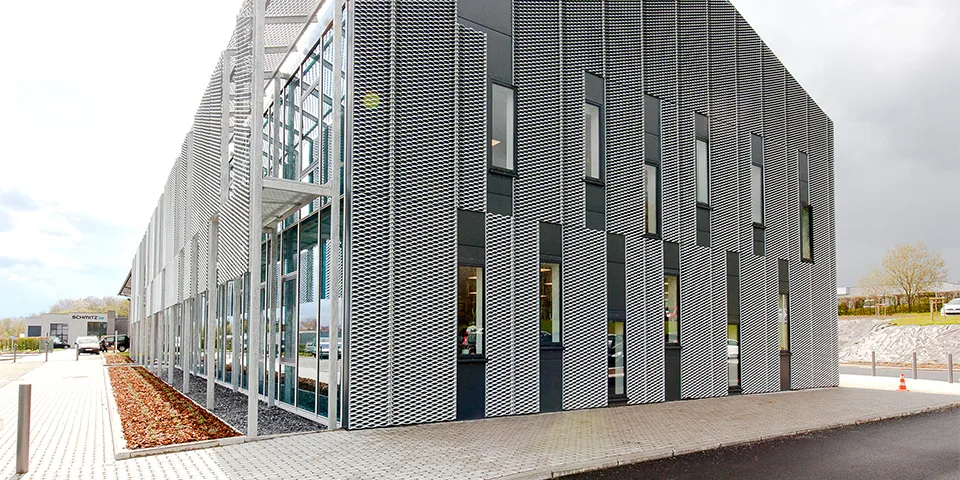
Animal health and exploration centre in Ciney. (Photo: Lieven Van Landschoot)
InfoZinc is an interest group formed through the merger of two national organisations: Stichting Doelmatig Verzinken (SDV) in the Netherlands and ProGalva in Belgium. The merger was completed in 2010. From the outset, its main mission has been to promote hot-dip galvanising throughout the construction chain, from architects, engineering consultancies and clients to the parties carrying out the work, such as steel fabricators and contractors.
Bruno Dursin: « Knowledge transfer is one of our core tasks. To move forward, we need to make sure knowledge is not lost. We certainly don’t lack technical knowledge. This is most often reflected in the assessments and inspections carried out by InfoZinc. We also have a helpdesk, which is a source of knowledge that is always available. Training for professionals and students also has its place in our organisation, alongside in-house training at galvanising plants. We are also very strong in technical datasheets, which cover all kinds of technical topics, and in the flow of information on our website. Our knowledge is available to anyone who is interested. »
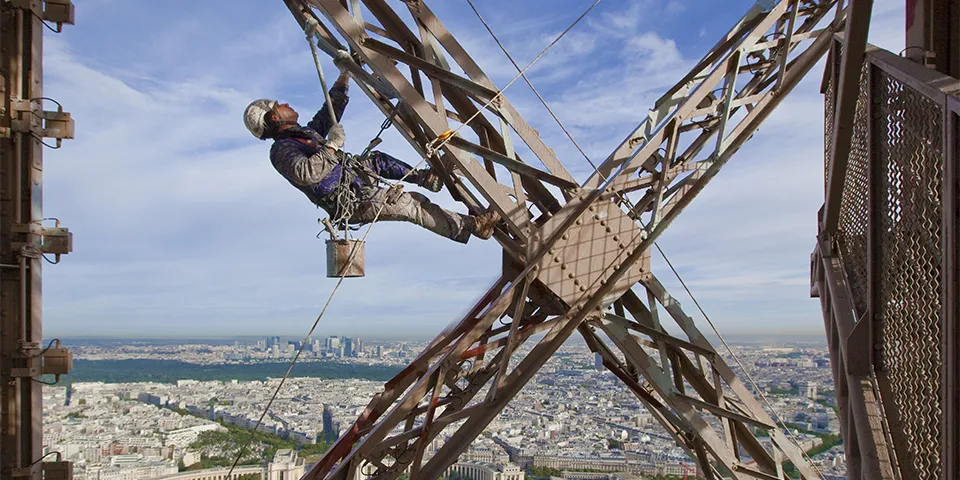
Eiffel Tower. (Photo: Stéphane Compoint)
Dos and don’ts
Promoting galvanising is a particularly intensive activity. We engage directly with architects, steel fabricators and engineering consultancies, and the associated visits and information sessions are always lively. Bruno Dursin: « Project visits are very popular. On site, you can see the results for yourself and get a better understanding of the dos and don’ts when using galvanised steel, and of how hot-dip galvanised steel can meet architects’ and clients’ challenges and requirements. »
Stand the test of time
Knowledge transfer, market development and promotion form a kind of foundation for our work in bringing hot-dip galvanising closer to our target groups. Bruno Dursin: « We literally go out and spread the word. We spend half our time on the road, organising information sessions and training, and visiting projects. We are in close contact with the market. I think that’s important, otherwise you end up in an ivory tower. In my view, purely theoretical knowledge is of little value if you don’t understand what the market needs. When you are in touch with the market, you get a better sense of what is happening. Raising awareness is central to this. When an architect starts working on a project, they generally begin by looking at materials. Which materials should I choose, and in what context? Those are the questions they ask themselves. And even when an architect chooses steel, that doesn’t necessarily mean they will think about its surface treatment. Do they consider what their building will look like in twenty or fifty years? For me, that is an important question, particularly from a sustainability perspective. The materials used must be durable and stand the test of time. Unfortunately, whether it’s concrete, steel or wood, I see too many applications in today’s streetscapes that make me think: why didn’t they give this proper consideration?
Kaseco. (Photo: Joost Demuynck)
Buildings that are barely five or ten years old can sometimes look very unattractive. Much more attention needs to be paid to this, after all, it is something you pass on to the next generation. Hot-dip galvanising steel is an effective answer to this challenge. »
ABSOLUTELY ZINC
Four years ago, IZB launched the ABSOLUTELY ZINC awareness campaign. Developed in consultation with its members, the campaign aims to raise awareness of the benefits of hot-dip galvanising. Bruno Dursin: « We have documented and substantiated the safety of galvanising in detail. For more information, see our six-point manifesto on our website, www.absolumentzinc.be . »
You came up with the ABSOLUTELY ZINC campaign… Bruno Dursin: « You need to inspire people and convince them. To do that, you need a strong message. I’ve found that our information sessions and project visits hit the mark. Our message about safety is being heard and is not being questioned. I’m sincere in what I say, too. I value the authenticity of the process: you can see straight away whether steel has been galvanised well or badly. What you see is what you get. And that really impresses me. You see so many imperfections hidden in the construction industry. Galvanisers are skilled professionals. They know galvanising inside out and can’t stand shoddy work. That’s what appealed to me. It fits with how I see the construction sector. »
Hot-dip galvanising means durability
This brings us to Bruno Dursin’s passion: circular construction. « Galvanising contributes to the circular recycling of steel. Galvanised steel is inherently circular. With hot-dip galvanising, you don’t need to touch the steel for 80 years. That means that to give steel a second life, all you need to do is dismantle it and reassemble it somewhere else. No more problems with painting, touch-ups or repairs: galvanised steel can be reused without any environmental impact. Secondly, zinc itself is 100 % circular. When steel is melted down, the zinc can be fully recovered as zinc dust, which can be reused as a raw material to produce secondary zinc. The third argument is that zinc sacrifices itself to protect the steel. This means that if the steel is damaged during installation or dismantling, cathodic protection prevents it from rusting. In other words, the steel is guaranteed lifetime protection. »
Eiffel Tower: maintenance costs of €4 million
It is true that the Eiffel Tower is not a beacon of sustainability. Bruno Dursin: « The big problem is maintenance. It is a painted steel structure that needs a new coat of paint every eight to nine years. If it had been galvanised, it would have needed no maintenance for the first eighty years. This is just one example among many. We still don’t think enough in terms of whole-life costs. Painting maintenance on the Eiffel Tower costs €4 million each time, or fifteen per cent of the original construction cost. You don’t build something only to see it disappear after five years. I wouldn’t go so far as to say we build for eternity, but the difference is nevertheless striking. We have a moral obligation to ensure that buildings remain attractive. Peeling paint bothers me. Take a look around the neighbourhood: there are farms with gates where the paint is coming off and the steel is corroded. You might say that’s to be expected, as farmers have other things on their minds. But a little further along, there is another farmer with a galvanised fence. They don’t want to maintain it either, and it is still in good condition. Extend that reasoning to the streetscape in general: you don’t want it to feel run-down. Clients give maintenance very little consideration, and the public authorities don’t have the money. Painted lighting columns look dreadful after 10 years. Galvanised columns, on the other hand, keep shining to the end of time. By choosing galvanised steel, you get a maintenance-free solution. » For the IZB director, this is a moral obligation and part of our quality of life.
The Silo, Copenhagen
Poor-quality steel
Steel quality plays an important role in hot-dip galvanising. Bruno Dursin: « Steel quality has a significant impact on the final result, particularly on the adhesion of the zinc coating. InfoZinc has published a suitable specification on its website so that specifiers can demand the highest standard of galvanising. The silicon and phosphorus content of the steel is particularly important. Choose quality and don’t let anyone palm off poor-quality steel on you. »
Good design
The design of components is another aspect of the same issue, and also involves a great deal of knowledge transfer. Bruno Dursin: « We also give architects, designers and engineers specific advice on how to design the components they want to galvanise. Bear in mind that the zinc bath is at +/- 450 degrees. You can’t just put anything into it, so the design must incorporate appropriate construction details and take every aspect into account to ensure safe galvanising. »
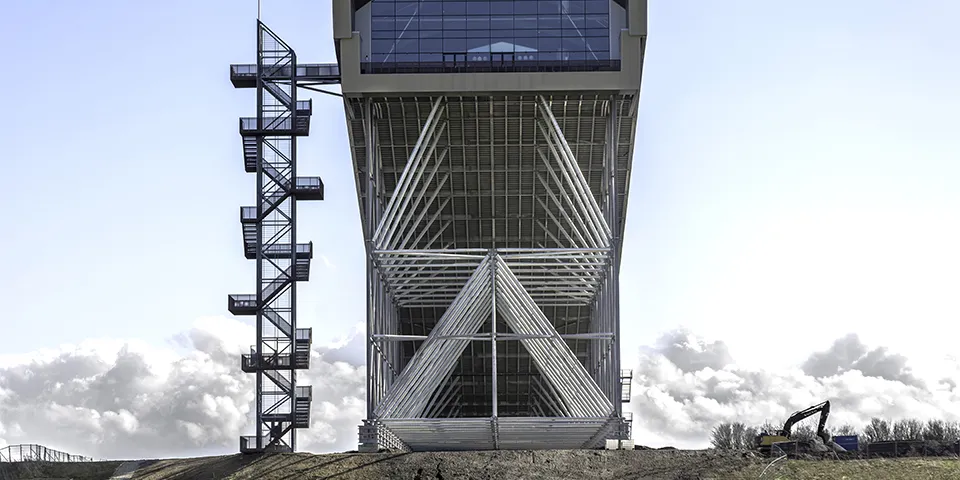
Snow world. (Photo: Jochen Verghote)
The future
The future looks promising for IZB, but the director stresses that the question of ‘safety’ must not be neglected. Bruno Dursin: « We need to keep giving our manifesto our full attention and show that we are ready to follow an ever-better and more rigorous path. I am convinced that clients and public authorities are increasingly aware of whole-life costs. There are always maintenance costs, and everyone knows they need to be taken into account. The fact is that circularity is not a passing fad. In this respect, we have a wealth of strengths and opportunities. Facade cladding, for example, is an area of application that still does not receive enough attention. We recently published a booklet on The Silo in Copenhagen. The project has won several international awards. It is a particularly successful example of galvanised steel being used as facade cladding. Our path is full of new opportunities and challenges. »
Galvanising as a circular solution
Galvanising and circular construction go hand in hand. Bruno Dursin: « When it comes to galvanising, we achieve very good results with repair, reuse and recycling, and have some very compelling arguments.
The Dutch Directorate-General for Public Works and Water Management’s Circular Guide Rails project is a good example.
The conclusion of the market exploration is that, in practice, guide rails can be refurbished responsibly. Refurbishment and reuse bring significant environmental benefits, reducing environmental costs by up to 70 per cent. Refurbishment is also cheaper than manufacturing new rails and meets the strict safety requirements that apply to guide rails.
For the Dutch Directorate-General for Public Works and Water Management, circular recycling of guide rails is one way to put circularity into practice by 2030 and thus use as few primary raw materials as possible. The exploratory work on circular guide rails covered the entire refurbishment chain, in which used guide rails are given a second life after being dismantled, cleaned, stripped of their zinc coating, galvanised again and finally reinstalled alongside roads.
TwynstraGudde and LBPSight supported the process as independent parties, taking account of the different interests and enabling everyone to contribute their own expertise. This resulted in a shared understanding of the business case, and all parties in the chain expressed their commitment. This enabled us to establish together that the chosen solution was technically and economically feasible. We succeeded thanks to everyone’s openness and enthusiasm. We will now work on setting up the pilot project. In the future, the Dutch Directorate-General for Public Works and Water Management will issue more and more circular tenders. I am thinking, for example, of lighting columns and motorway gantries.”
Question about this story? Ask your question
Companies in this story
Keep following this
Get an email when a new story is published. No account needed.
- SubjectNews
- CompanyInfoZinc Benelux







