











A skatepark making waves in Tournai
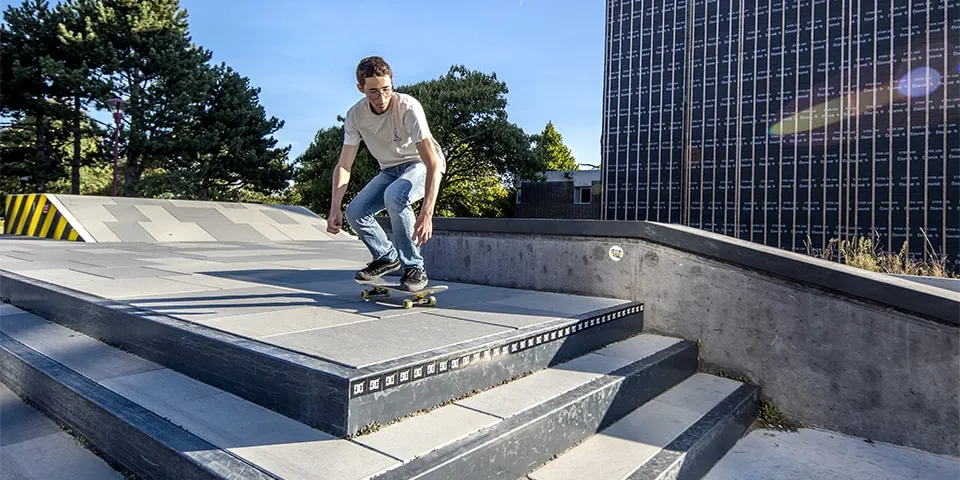
Opened on 23 September 2017, Tournai’s outdoor skatepark has been delighting riders of all ages ever since. Whether on a skateboard, BMX, scooter or roller skates, the city’s hundreds of enthusiasts enjoy riding features that mimic urban street furniture, such as paving, benches, ramps and steps, while delivering the same sensations. For this part of the facility, the architect chose EBEMA’s highly durable large-format concrete slabs.
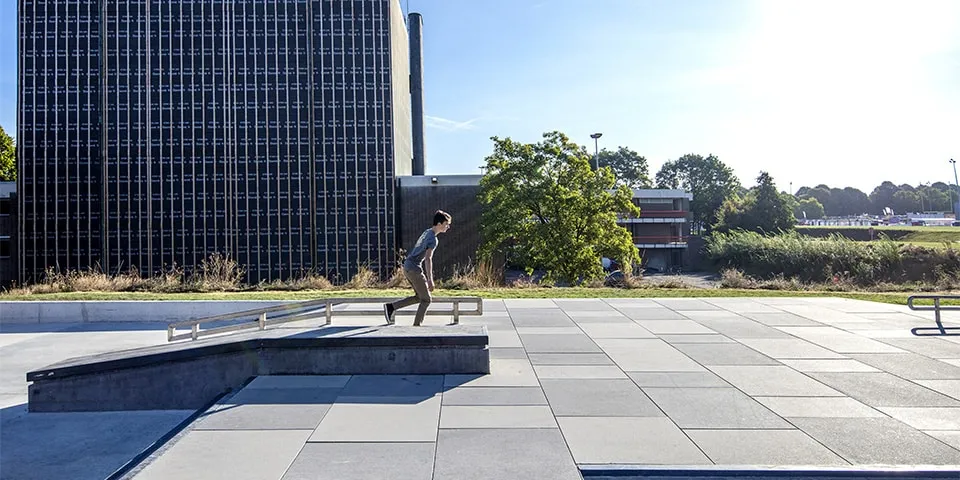
The Tournai skatepark comprises two distinct areas, including a “streetpark” for a more typically urban style of riding.
Situated between the Maison des Sports and the Maison de la Culture de Tournai, the new skatepark is accessible by various modes of transport and forms part of a genuine sports hub: a sports hall, hockey pitch, outdoor fitness equipment, American football pitch and, above all, a dirt track for BMX. Designed by the architects at L’Escaut and built by contractor TRBA, the skatepark is L-shaped and divided into two distinct areas: a “flowpark”, with a sequence of curves and changes in level for riding on a smooth surface, and a “streetpark” for a more typically urban style of riding. The question of the right material arose when it came to surfacing this second area.
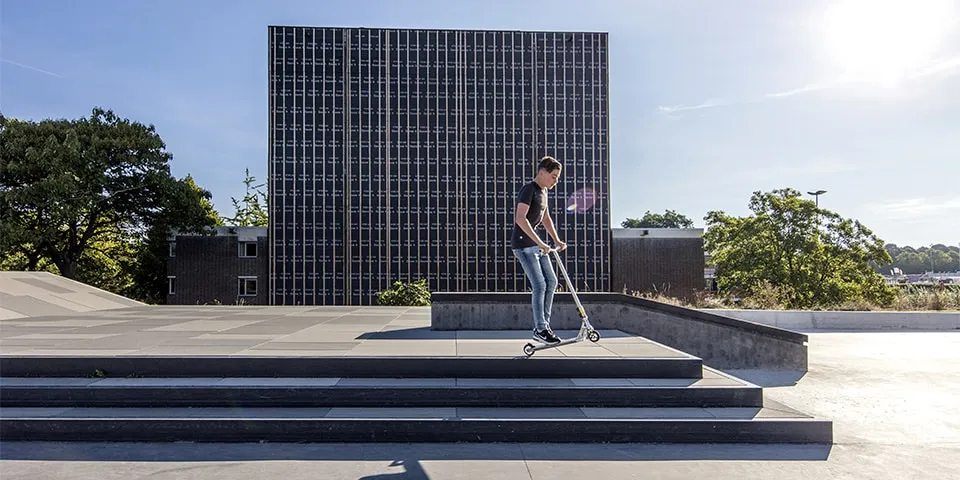
To recreate riders’ favourite urban terrain, the architect turned to EBEMA’s large-format concrete slabs.
Standard slabs for realistic sensations
To recreate riders’ favourite urban terrain, the architect turned to EBEMA’s large-format concrete slabs. Alain Beutels, Account Manager, who oversaw the project for EBEMA, explains: “The architecture practice initially wanted to use cast concrete slabs from our ‘Smooth elements’ range. We recommended pressed and vibrated concrete slabs instead, as they are less smooth and, above all, far less prone to scratching. The final choice was therefore Megategel, a standard slab with a very dense structure, thanks to its wearing course of much finer aggregate and higher cement content. It is also more durable, less expensive and easier to install.”
Taking advantage of the wide choice of formats and colours available, the architect devised a creative laying pattern using 3 different sizes (100 cm x 25 cm, 100 cm x 50 cm and 100 cm x 100 cm) in 2 colours. The slabs were chosen with a smooth, tile-like finish for better grip and straight edges. They are laid edge to edge, without joints. Having the same slab available in several sizes means there is no need to cut them. Each slab has a small chamfer and a spacer for installation, both of which would be lost if it were cut. Alain Beutens says: “The chamfer between each slab makes a noise as the wheels of skateboards and other equipment roll over it, and that is precisely the point. The aim is to replicate an urban setting, giving riders the same sensations and sounds as they would get from real street furniture.”
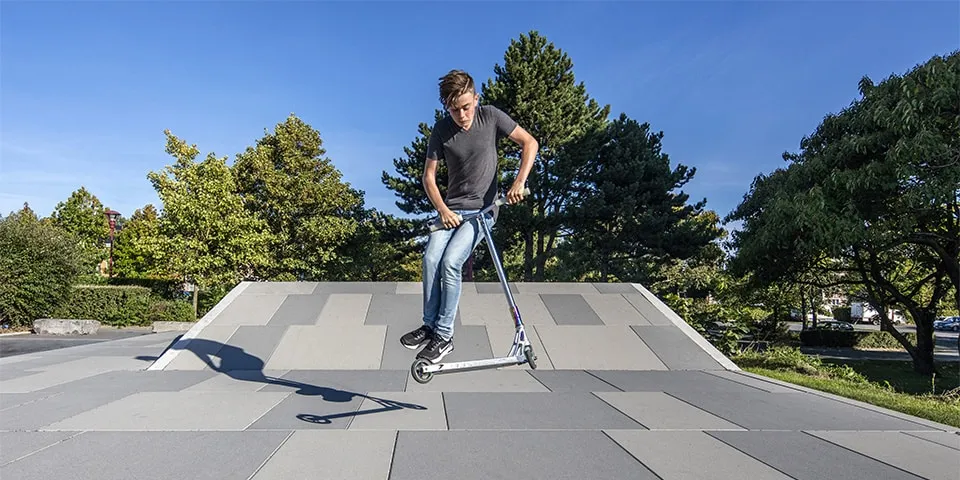
The slabs are laid edge to edge, without joints. The chamfer between each slab makes a noise as the wheels of skateboards and other equipment roll over it, and that is precisely the point!
Details matter
When it came to installation, the question arose of how to protect the slab edges, particularly where they form an external corner. Normally, the slabs would have had to be cut to achieve a perfect join. But skating over cut edges would have worn them down prematurely, with the added risk of water ingress. At a site meeting, Alain Beutens recommended covering the edges with a steel angle profile. This was done. The result? A much smoother ride, while also protecting the edges. The distinctive sound of wheels on metal further enhances the site’s “urban touch”.
This is EBEMA’s first skatepark. Given the client’s satisfaction and the enjoyment of its users, this excellent reference is sure to lead to others!
Question about this story? Ask your question
Keep following this
Get an email when a new story is published. No account needed.
- SubjectNews







