











A high-flying asset for Huy’s appeal
Texte Philippe Selke | Photos Georges De Kinder
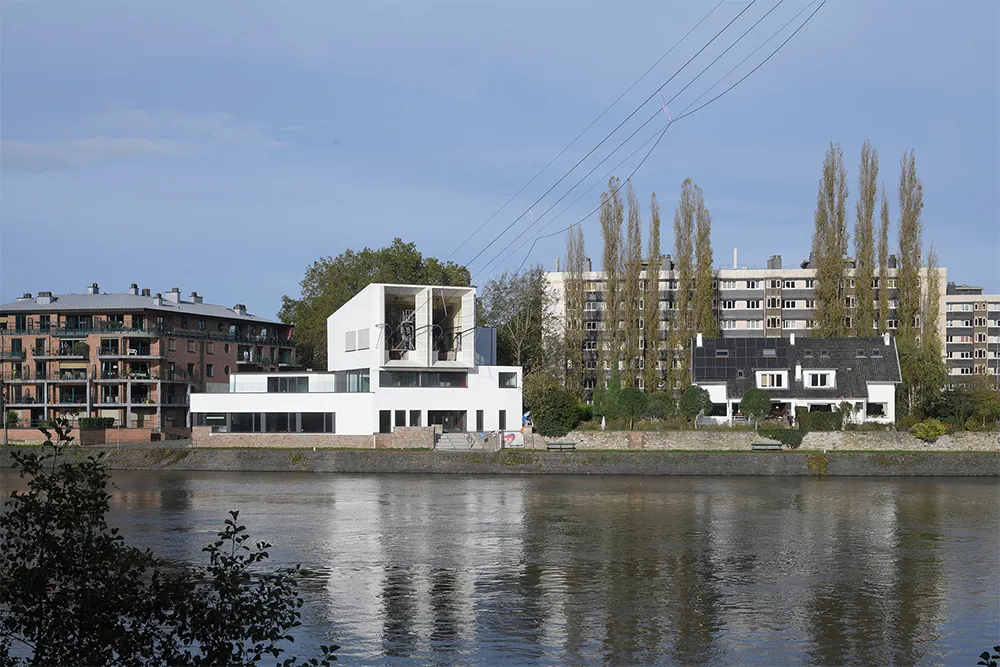
From 1958 until 6 April 2012, a day marked by a tragic helicopter accident, the left bank of the Meuse was connected to the heights of Huy (La Sarte) by a cable car. Since then, much has changed, and the city has decided to bring a cable car back into service. Two service contracts were therefore awarded, first to assess the damage caused by the 2012 accident, and then to carry out a comprehensive study for the renovation and modernisation of the cable car. Both assignments went to Contraste architecture (now UMAN Architect), working with the French engineering consultancy E.R.I.C (Etudes et Réalisations d’Installations à Câbles).
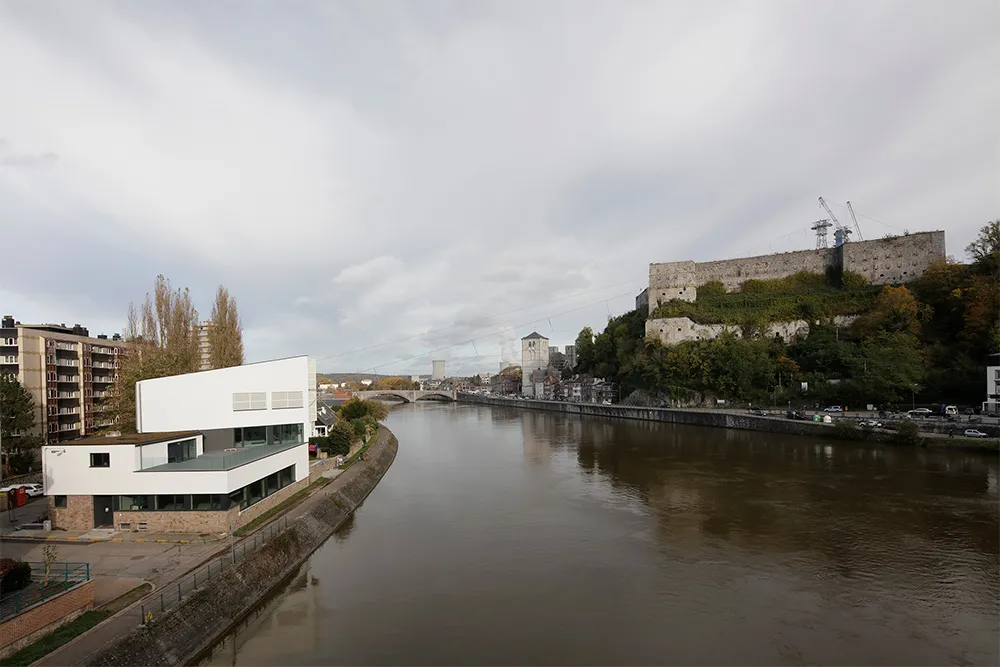
With its three stations and a lift at the fort, the new cable car will carry not only tourists, but also materials for restoring the fort, which is inaccessible by road. A special vehicle can be fitted to the cables in place of the cabins for this purpose. Sébastien Deckmyn, Associate Architect at UMAN Architect, who worked with his colleague Fabrizio Tengattini on the design of the building works for the project, explains: « Renovating the fort to develop a full tourist offer there, complementing the amusement park accessible from the upper station, is indeed one of the municipality’s ambitions. The cable car will therefore be very useful in making this happen. Initially, we tendered for the expert assessment to determine insurance compensation following the accident, and then for the cable car’s rehabilitation. We also won the contract to revitalise the Batta esplanade, which is close to the lower station (see following article). »
The French firm E.R.I.C (Fabien Abinal) handled the cableway installation, while UMAN Architect was responsible for renovating the upper and lower stations and installing a lift at the fort. The project, under construction since September 2020 by the joint venture between Cop & Portier and BPC Wallonie, is now virtually complete. The vehicles are due to be delivered any day, followed by a testing phase, with the cable car scheduled to enter service in spring 2024. The City of Huy will ultimately operate it. The rehabilitation was largely subsidised by the Commissariat Général au Tourisme.
Two buildings to modernise and a lift
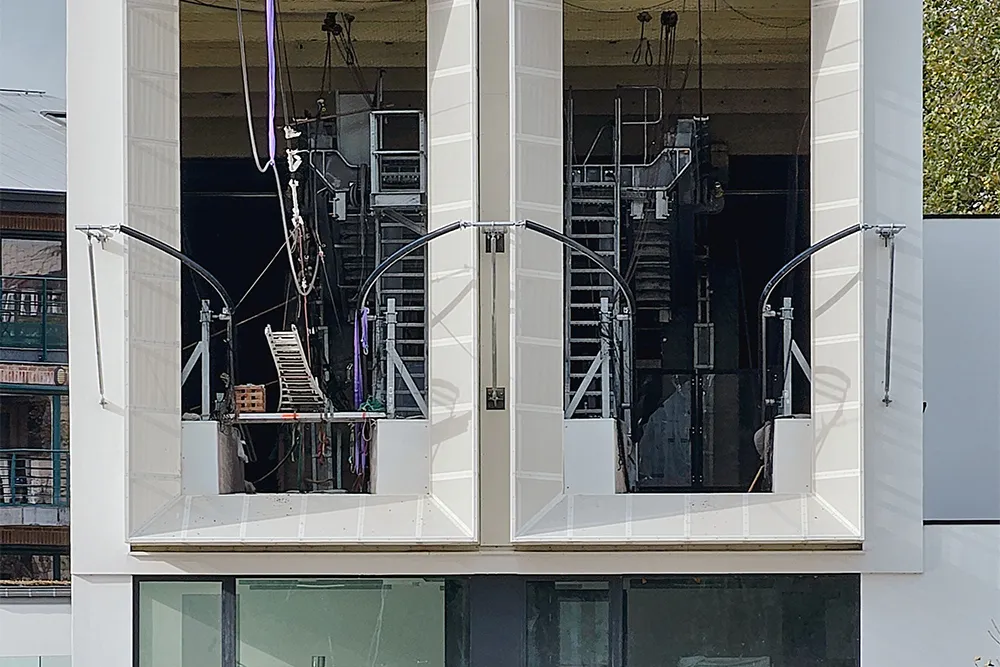
« For the station renovations, the idea was for the tenderer to retain as much of the existing structure as possible, so that the new machinery could then be installed inside. Our work therefore focused mainly on modernising the façades and interior spaces, including the creation of two large backlit, micro-perforated steel portals around the cabin entrance and exit bays, giving the impression of two tunnels. The rest of the façades were finished with white render over insulation, simplifying the appearance of a building with many projections. » The interior has been refitted to include offices, a staff canteen and a concourse that can also be used as an exhibition space. Outside, a huge terrace is waiting for a hospitality operator. A screen wall to close off some bays and a green roof provide pleasant views for visitors arriving from above. The upper station has been designed in the same style and adjoins a restaurant that is already open, a welcome stopping point for the many cyclists tackling the Mur de Huy, with the « Mont mosan » just a little further on.
At the intermediate station, a glazed lift runs from the platforms to the fort, which is now accessible to people with reduced mobility (PRM). The city hopes to open a brasserie there so tourists can enjoy the magnificent panorama over the city.
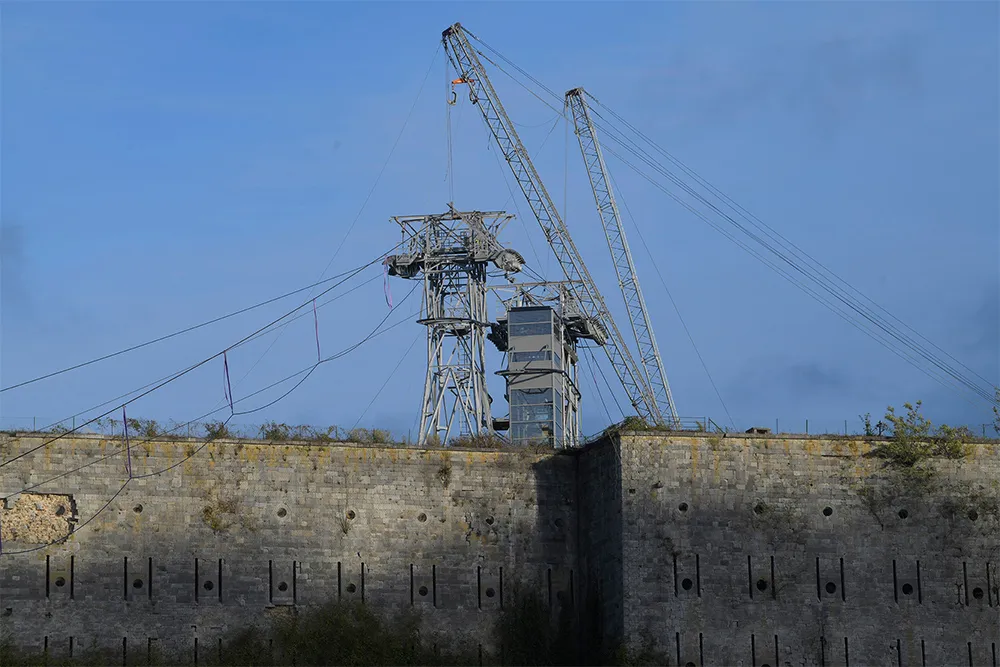
The pylons were reinforced to meet current standards and then repainted, while their heads were replaced.
Construction challenges
The main challenge was the delivery schedule, as the cableway contractor faced shortages of electronic components. It also discovered during the works that the pylon between the intermediate and upper stations was badly damaged. As the city would have needed to buy land parcels to gain access to it, the pylon had to be demolished and rebuilt, leading to delays and additional costs. This came on top of the sharp rise in steel prices, which was reflected in the price revision clauses.
For a Belgian architecture firm, working on a cable car is a rare opportunity. In Namur, UMAN built a structure around the machinery, while in Huy the work involved a « simple » renovation. Namur has gained a new urban mobility option, while Huy has acquired an asset with both tourist and technical value. Which municipality will take the plunge next? Dinant, Durbuy or even Liège, where some dream of connecting the Saint-Léonard district to the Citadel slopes by cable, while others would prefer a route between Val-Benoît and the CHU, via the University? The sky is the limit!
Question about this story? Ask your question
Keep following this
Get an email when a new story is published. No account needed.
- SubjectNews







