











A European first for Infrabel at Franière
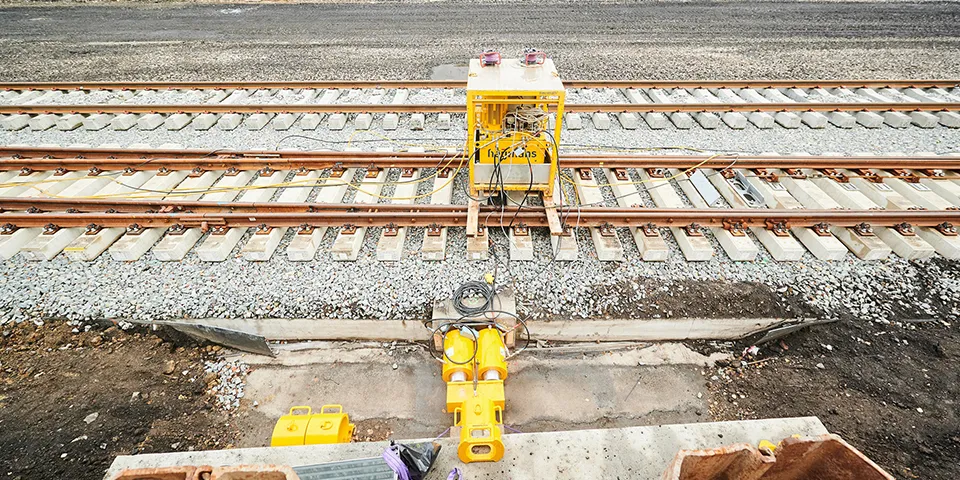
On the weekend of 5 and 6 September, the second phase of an operation unprecedented in Europe took place on the Namur-Charleroi railway line: the sliding into place of a huge concrete slab, 480 m long and weighing 6,100 t, carrying 1 km of track and 4 sets of points. For Infrabel, the benefits are numerous, both in terms of speed of execution and safety. This innovative technique could be used again on other projects in future, subject to certain conditions.
The slab was pushed into place as planned, at a maximum speed of 1 m/hour.
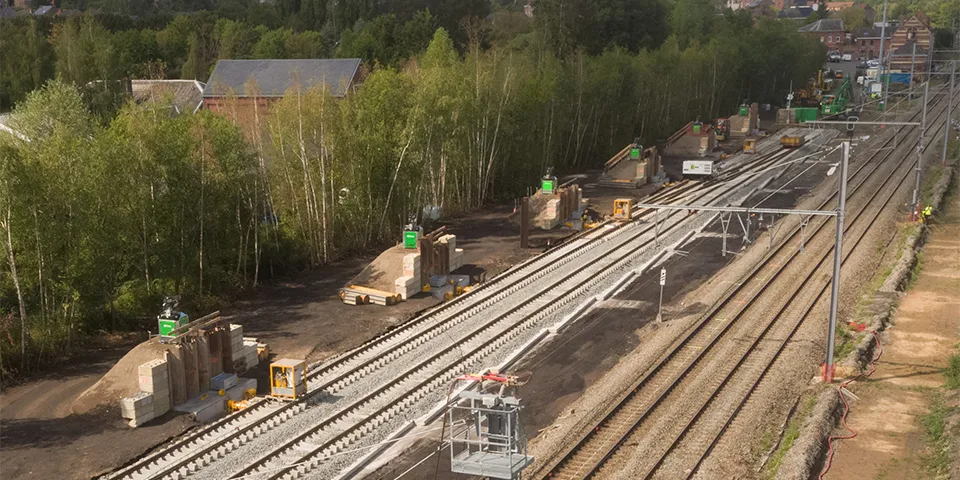
Work began in early May alongside the Walloon backbone (line 130), close to Franière halt. Infrabel’s teams first built a slab on the site of a former goods yard, using 1,300 m³ of concrete and 300 tonnes of reinforcing steel. This was an XXL structure, measuring 480 m long, 8 m wide and around 30 cm thick. It was then fitted with 2 x 480 m of track, ballast and 4 sets of points. The result? A ready-to-use “rail network Tetris block”.
Installed in a single weekend
The second phase of the work took place on 5 and 6 September:
the giant structure had to be pushed into its final position, a distance of around 16 metres. This was no mean feat for a structure weighing 6,100 tonnes, equivalent to 18 fully laden long-haul aircraft!
Benoît Gilson, Managing Director of Infrabel, François Bellot, Federal Minister for Mobility, and Sophie Dutordoir, CEO of SNCB, were on site to witness this European first.
Taking advantage of an exceptional closure to rail traffic, around 100 workers, assisted by a dozen machines and cranes, began operations late on Friday evening. They first dismantled the existing infrastructure, which had reached the end of its service life. Once the rails, ballast and sleepers had been removed, the site was cleared for the installation of the new section of infrastructure. To move this colossal mass, technicians built abutments with foundations 3 metres deep, against which 16 jacks were positioned along the full length of the slab. The slab was then pushed into place as planned, at a maximum speed of 1 m/hour.
Traffic resumed at 5.30 am on Tuesday, after around 70 hours. It initially ran on a single track, before returning to two tracks a fortnight later.
A host of benefits
The innovation used on the Namur-Charleroi line is primarily a way to limit the impact of works on rail traffic. For Infrabel, the investment is broadly equivalent to that required for a traditional work method. But the benefits for customers, and the fact that the work takes place away from operational tracks, improving worker safety, are real advantages!
To move this colossal mass, technicians built abutments against which 16 jacks were positioned along the full length of the slab.
In practice, pre-building this movable slab made it possible to:
• Limit the use of single-track working to 18 days (and 3 weekends), compared with 49 days (and 8 weekends) using a traditional method;
• Limit the full closure of rail traffic to 3 weekends, compared with 5;
• Cut by a factor of 4 the period during which a post-work speed restriction is in force.
In addition, the curve on this section of line has been redesigned, allowing trains to run at 120 km/h instead of 100 km/h under the previous layout.
An innovation that can be used on other projects
This European first will be evaluated, but its benefits already make it clear that the technique will be used on other projects. Infrabel is already studying its feasibility for two infrastructure renewals on the Athus-Meuse freight line.
Unfortunately, this innovation cannot be applied to every project. It requires sufficient space alongside the tracks, with access for the delivery of materials. The technique is particularly useful because it allows new, fully prefabricated sets of points to be installed.
Question about this story? Ask your question
Keep following this
Get an email when a new story is published. No account needed.
- ThemeTransforming infrastructure and territories
- SubjectNews







