











A CO2 monitor for every remote worker? Renson leads by example
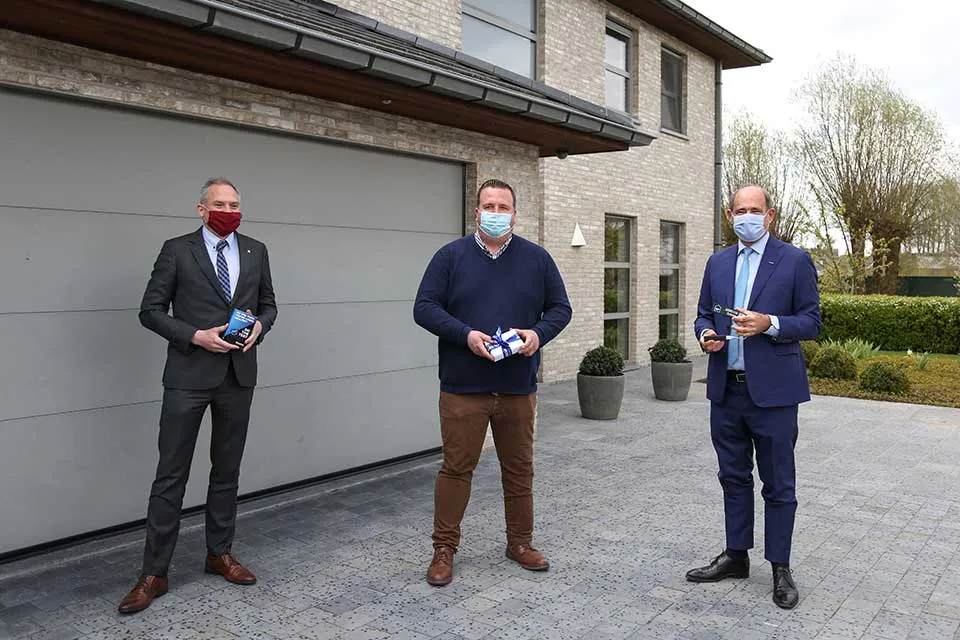
At Renson, ‘Employees’ Day’ is all about healthy air at home.
Working from home will remain ‘the new workplace’ in 2021 too … but what about indoor air quality? Neither companies nor employees really know. That is why, on 15 April, for ‘Employees’ Day’, Renson will give every employee their own CO2 monitor. This will allow them to measure the quality of the air they breathe at home and take action in good time if it falls short. Employees who do not work from home will receive one too, because good indoor air quality matters to everyone … and will continue to do so even after the health crisis is over.

Royal Decree on workplaces
“The Royal Decree on workplaces requires us, as employers, to ensure that workers in enclosed workplaces have healthy air, and to take action if CO2 concentrations are consistently above 1200 ppm (parts per million),” explains Paul Renson (CEO Renson). “As ventilation specialists, we naturally have a head start. But with 420 colleagues currently required to work from home, we obviously do not know what the air they breathe there is like. That is why every Renson employee in Belgium, including those who do not work from home, will receive a CO2 monitor on 15 April, for ‘Employees’ Day’. This small device will enable them to check their indoor air quality, because breathing healthy air at home is in everyone’s interest.”


Paul Renson: “We can ensure good indoor air quality in the office, but we do not know what the air is like in the home office. That is why every Renson employee will receive a CO2 monitor.”
For employees who do not work from home too
But Paul Renson also wants to include employees who do not work from home: “Wherever they work, we want our employees to breathe the healthiest air possible, whether in the office, at our production sites, in meeting rooms, showrooms or at home. It is just as important for the family members of those who cannot work from home to know at least what the air quality is like in their homes. As ventilation specialists, we have years of experience, but by giving our employees the chance to experience this in their own homes, many will gain an even greater appreciation of the benefits of healthy indoor air and will therefore be able to share our message with even more conviction.”

A CO2 monitor as a sixth sense for healthy indoor air
It has long been known that ventilation helps minimise the risk of contaminated viral particles (aerosols) spreading indoors. But a lack of sufficient fresh air can also cause headaches, drowsiness and concentration problems, and even lead to respiratory infections and asthma over the long term. This will therefore remain an important issue in the post-COVID world. Now that many employees spend 8 hours a day in their own home office, employers have more responsibility than ever to ensure they stay fit and healthy. “And as an employer, what better way to do that than to provide them with a device that alerts them when it is high time to air the room or increase ventilation?” says Paul Renson. “CO2 is a colourless, silent, inaudible and odourless gas … so anyone spending a lot of time in the same room, as almost all remote workers do, will not notice that indoor air quality is deteriorating.”

Healthy indoor air
CO2 is present in the air we breathe and is a good indicator of indoor air quality. When CO2 concentrations rise to alarming levels, it means that the air exhaled by occupants is not being refreshed sufficiently and, as a result, viral particles are not being diluted in time. According to the Flemish Social and Economic Council (SERV), the risk of infection is multiplied by 10 when an environment is not adequately ventilated. In airtight, well-insulated and poorly ventilated spaces, CO2 concentrations quickly exceed 1200 ppm (parts per million). The air is then far from healthy. By comparison, outdoor air generally contains 400 ppm of CO2. A maximum of 800 ppm is ideal in a home, 1000 ppm is tolerable and 1200 ppm is the upper limit, beyond which the air can no longer be considered healthy.
Paul Renson: “A CO2 monitor alerts you when it is time to air the room or increase ventilation. Whether or not you work from home, this device detects what you cannot sense for yourself and alerts you as soon as indoor air quality falls short.”
Question about this story? Ask your question
Keep following this
Get an email when a new story is published. No account needed.
- ThemeFaçades and building comfort
- SubjectNews







