











A better drainage system for Circuit Zolder
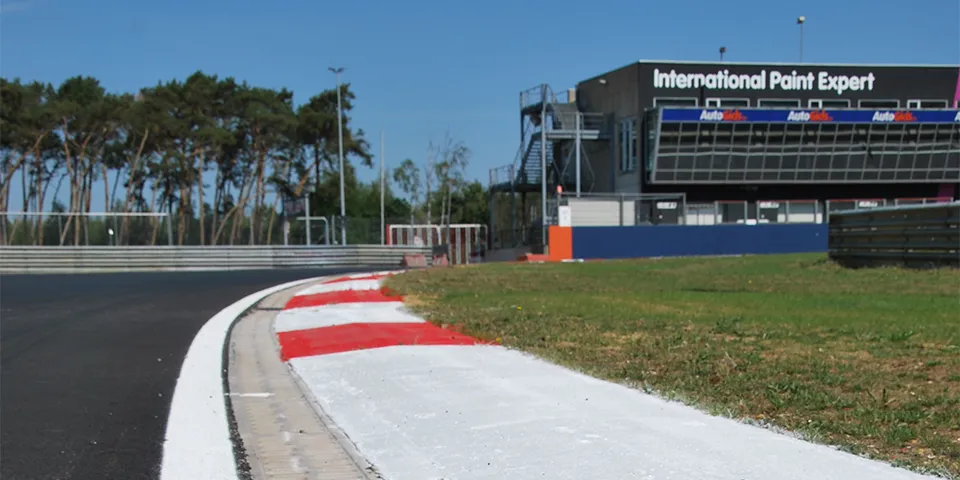
Together with main contractor APK Group, “Circuit Zolder“ has recently completely redeveloped its 4-kilometre circuit. The work ranged from surveying the track to laying a completely new layer of asphalt. An important part of the renovation was an improved drainage system. “Thanks to ACO’s Monoblock and Q-Max, we now have an even more stable and smoother circuit,” explains David Vanderbeek, Infrastructure, Logistics & Operations Manager at “Circuit Zolder“.
Because of the heavy wear it is subjected to, a race circuit traditionally needs to have its surface renewed every 10 to 15 years. David Vanderbeek explains: “Rather than simply resurfacing the track, this time we opted for a more extensive renovation. As well as a new layer of asphalt, several gravel traps were upgraded to meet safety standards, and some kerbs were renovated. In many places, the grass level was lowered by a few centimetres so that the asphalt sits slightly higher, allowing water to drain away more effectively. Finally, we also looked at how we could improve drainage across the entire site without undertaking too much work.”
The circuit was surveyed and modelled in 3D, revealing that some of the gradients in the drainage system included a bend or a hump, causing water to collect. “We tackled the problem using this digital model,” David Vanderbeek continues. “We examined the overall surface levels to establish the optimum drainage direction. The track is naturally wet when it rains, but it is crucial that no puddles remain as it dries.”
Monoblock Roaddrain is suitable for use in almost all areas subject to extreme loads.
Monoblock and Q-Max
“Circuit Zolder“ called on ACO’s expertise for its drainage system, and the company supplied both Monoblock Roaddrain and its Q-Max drainage system. Monoblock Roaddrain is suitable for use in almost all areas subject to extreme loads. Several race circuits around the world are equipped with this system. Q-Max, meanwhile, is the ideal drainage system for large surface areas. It is suitable for all types of traffic and allows rainwater and surface water to be stored temporarily.
David Vanderbeek explains: “In a number of places, we could not ensure that water infiltrated quickly enough into the available swales. This water needs to be collected by a drainage system, which may or may not lead to soakaway pits. ACO had already supplied similar products for Spa-Francorchamps circuit, among others, and came to meet us to present its range. The benefits were immediately clear. Monoblock’s major advantage is that the grating and channel are one piece, with no moving parts. When a racing truck unleashes all its horsepower on the circuit, Monoblock’s strength makes it an excellent alternative to a conventional welded grating.
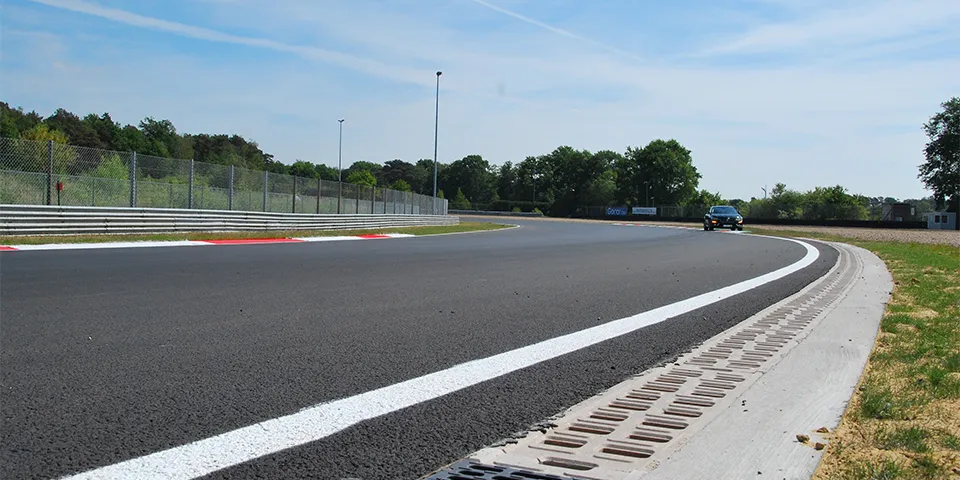
The overall surface levels of the circuit were examined to establish the optimum drainage direction.
Minimal irregularities
ACO was already familiar to contractor APK. “ACO products were specified in the tender and seemed to us to be the best system for this project,” explains Pieter Van den Eynde of APK. “We knew ACO as a reliable supplier of quality products, but installing Monoblock Roaddrain was a first for us. The work went very smoothly, and the results speak for themselves. Speeds and loads on a circuit are very high, so drivers feel even the slightest irregularity. We were able to reduce this to an absolute minimum, partly thanks to ACO’s products. This project is certainly an excellent reference for APK.”
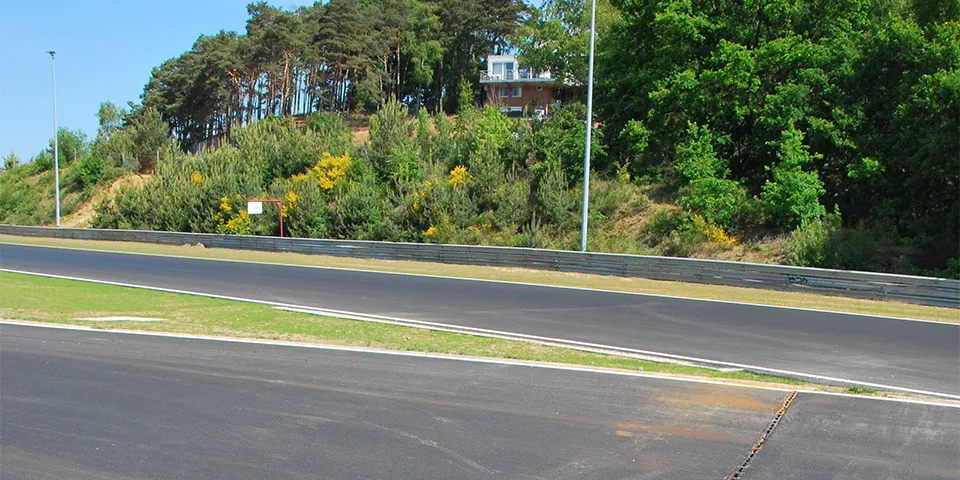
Q-Max serves as a concealed channel.
500 linear metres
A total of 500 additional linear metres of drainage were installed around the circuit. “Like Monoblock, the Q-Max drainage system has proved its added value. In some places, Q-Max functions as a concealed channel where safety requirements prevented us from installing conventional drainage. So far, both Monoblock and Q-Max have been doing an excellent job. The way the drainage was installed also deserves praise. In many places, it sits between the asphalt and the kerb, neatly set in concrete. Another important point is that our drainage system now has a much higher flow capacity than before, which is very welcome in this era of extreme weather. The most meaningful feedback naturally comes from the users themselves, and they are unanimous in their enthusiasm, from heavy goods vehicle drivers to our evening cyclists,” concludes David Vanderbeek.
Question about this story? Ask your question
Companies in this story
Keep following this
Get an email when a new story is published. No account needed.
- ThemeRenovating existing buildings
- SubjectNews
- CompanyACO







