











162-metre radar mast demolished with explosives
Texte Philippe Selke | Photos Nonet
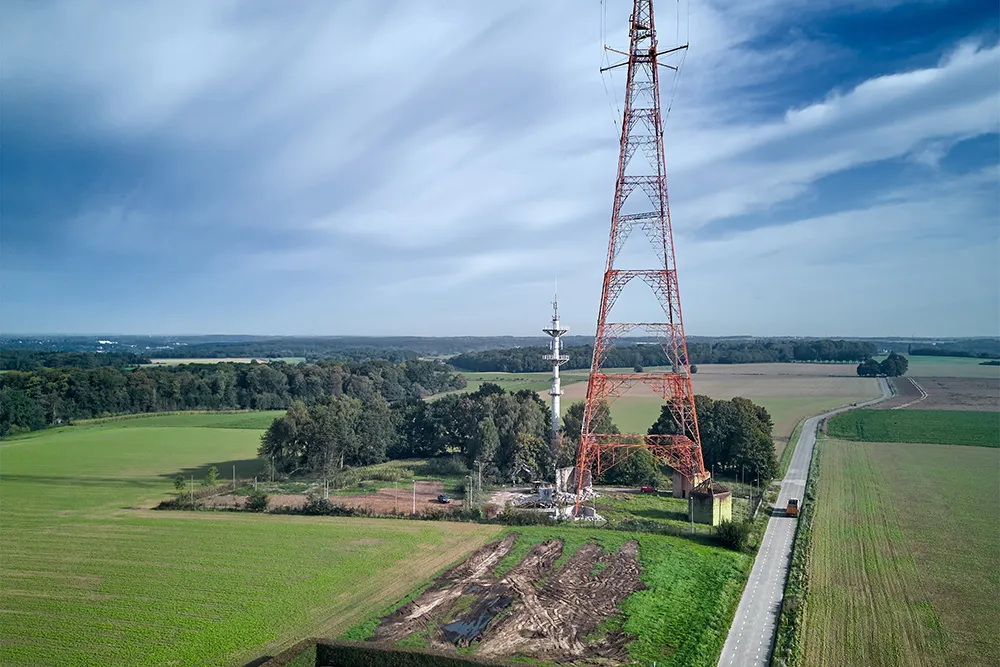
On 12 October, a 162 m-high former NATO radar mast in Court-Saint-Etienne was demolished with explosives by Pôle Démolition, which Namur-based contractor Nonet set up in 2022 to provide the people and equipment needed to develop demolition as a business in its own right. The operation was meticulously planned in view of the site constraints and, above all, the choice of method, which is still uncommon in Belgium.
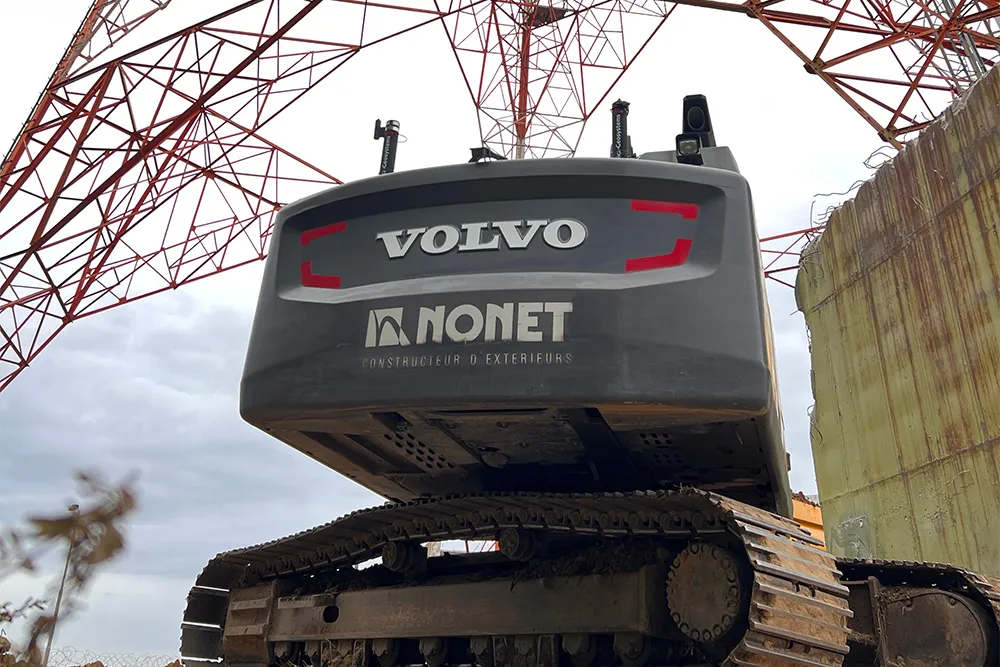
Demolishing the F16 shelters at Florennes air base, several towers in central Namur, … Nonet is now also targeting this type of standalone demolition contract, alongside its traditional earthworks and construction activities. And the opportunity to demolish a steel structure more than half the height of the Eiffel Tower does not come along every day… Set amid farmland, this 1950s-era mast had become obsolete and was a source of concern and expense for the landowner. Nonet therefore began assessing the various options in March 2022: conventional demolition using a heavy-duty crane, toppling it with a jack and winch cable, or bringing it down with explosives. With no plans available, Nonet first created a 3D model of the mast from a point cloud captured by drones, to gain the clearest possible understanding of the structure and how to demolish it.
Site constraints
Although it stood “in the middle of nowhere”, the mast presented several challenges for demolition. Its size ruled out the usual lifting equipment, even the equipment used to erect and dismantle large wind turbines. Gilles Durigneux, Director of Pôle Démolition at Nonet: “We would have had to sacrifice 4,000 m2 of farmland, dumping 5,000 tonnes of crushed stone to create two crane platforms. That was unfeasible in terms of both environmental impact and cost, so we had to think further.”
Toppling it using winches and jacks, meanwhile, carried too great a risk of instability, jeopardising control of the mast as it fell. An Astrid network antenna and a drinking-water reservoir are located close by, while a high-pressure gas pipeline runs along the edge of the site.
Using explosives
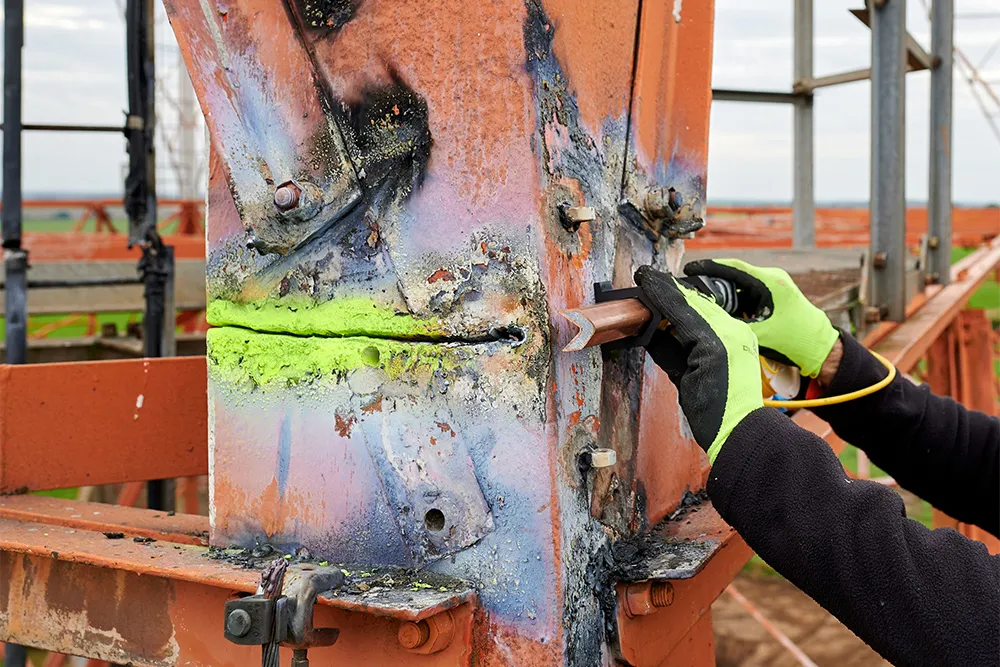
Toppling the mast with explosives proved to be the answer, offering faster execution, less disruption and improved worker safety. As an added benefit, this method was estimated to generate 30 times less CO2 emissions than using a crane. Gilles Durigneux: “We did not yet have this expertise in-house, so we looked for a specialist partner and eventually found one in France.” A steel frame does not behave like masonry, which will collapse straight down along its own axis. “There are many more unknowns. You have to account for wind loads and work out where to weaken the structure before bringing it down, … our 3D plans helped us answer all these questions.” The plans also made it possible to calculate the tonnage of steel to be recovered, which was essential for pricing the demolition.
The 3D modelling was, of course, accompanied by site investigations and other surveys. Obtaining the necessary permits took time, and the countdown was on, as the team needed to avoid the autumn storms and days that were too short.
D-day
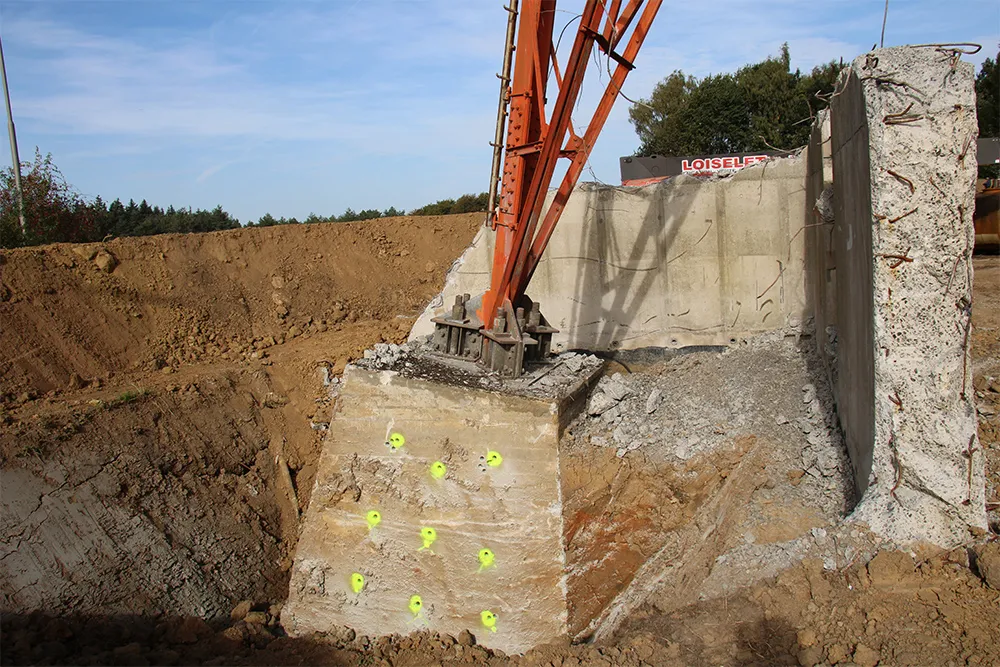
Before D-day, Nonet partially demolished the bunker-style walls around the footings, built earth bunds to contain debris, dug a peripheral trench to reduce vibration as a safety measure, and drilled holes in the footings to place the explosives.
When the big day arrived, Nonet moved quickly through the operations: receiving the explosives in the presence of the FPS inspection body, placing dynamite charges in the concrete footing, attaching “cutting” charges to the steel structure, installing the cables and detonators, carrying out a final safety check within a 350-metre perimeter, then firing the charges… To everyone’s surprise, the mast only toppled on the second attempt, as the extreme oversizing of the anchors had gone undetected in all the site investigations! The mission was accomplished, and the sang-froid of the Nonet teams deserves recognition: it enabled them to find a solution and finish the job before sunset. Two weeks later, the entire mast, cut up on the ground with a hydraulic shear,
had been removed.
Question about this story? Ask your question
Keep following this
Get an email when a new story is published. No account needed.
- SubjectNews







