A fine example of horizontal directional drilling for the installation of a drinking water main
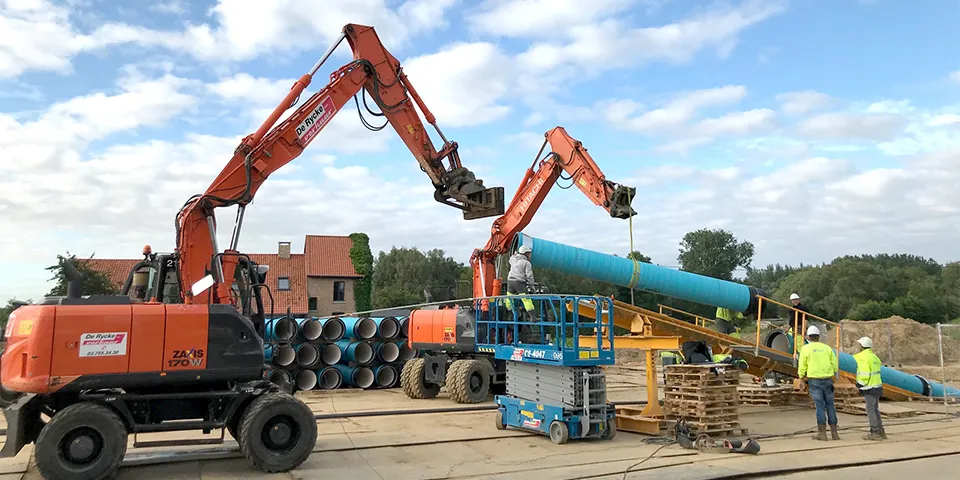
De Watergroep and water-link signed a long-term agreement at the end of 2016 to supply drinking water to Flemish Brabant. On behalf of water-link, an approximately 7 km-long cast iron drinking water main was installed between the pumping station at Pidpa’s site in Mechelen-South and De Watergroep’s supply facilities in Zemst. Saint-Gobain PAM Belgium successfully carried out the approximately 1 km trenchless section.
Thanks to this collaboration between Pidpa, water-link and De Watergroep, drinking water is supplied from water-link’s South production centre in Rumst to De Watergroep’s distribution point in Zemst. This is done via a new cast iron main with a total length of approximately 7 km, 6 km of which was installed in an open trench. The remaining section was installed using horizontal directional drilling. “It is a cast iron main with a diameter of 600 mm,” explains Bart Stulens, Area Sales Manager at Saint-Gobain PAM Belgium. “Two sections, each 500 m long, including a crossing beneath the E19, were successfully installed using horizontal directional drilling.”
On behalf of water-link, an approximately 7 km-long cast iron drinking water main was installed between Mechelen-South and Zemst.
Assembly on a ramp
In horizontal directional drilling, a steel drill string follows the route set out in advance, eventually emerging at the surface at the required location. Adding bentonite and using a rotary movement gradually enlarges the bore until it reaches the required diameter. Bart Stulens explains: “At a certain point, the bore is wide enough to accommodate the pipe. For this project, as it does generally, Saint-Gobain PAM Belgium prefers to use a push-fit joint. Cast iron proves ideal here because it allows angular deflection and tighter bends, unlike welded steel. With both welded steel and synthetic materials, the pipe has to be laid out over its entire length, and there is generally not enough room to do this during horizontal directional drilling.”
Saint-Gobain PAM Belgium successfully carried out the approximately 1 km trenchless section.
Durable cast iron
For Saint-Gobain PAM Belgium, ductile iron is the material of choice. “A cast iron pipe is extremely robust and retains its mechanical properties in the ground. What’s more, a cast iron pipe is entirely ‘cradle to cradle’. At the end of its service life, the pipe is crushed to remove the cement. It is then melted down and made into a new cast iron pipe. Whether installed in an open trench or by horizontal directional drilling, cast iron stands out as the most sustainable material. And sustainability has become a necessity in the industry today,” concludes Bart Stulens.
Question about this story? Ask your question
Keep following this
Get an email when a new story is published. No account needed.
- SubjectEquipment and machinery