Geogrid study for the Oosterweel Link
Geosynthetics have proved to be a cost-effective and efficient way of building up embankments. Unfortunately, because some design parameters remain uncertain, this solution is still rarely used in Belgium. The Oosterweel Link at Linkeroever is an exception. However, client Lantis is leaving nothing to chance. It commissioned Buildwise to compare geosynthetic deformations with the design calculations through monitoring, both in the short and long term.
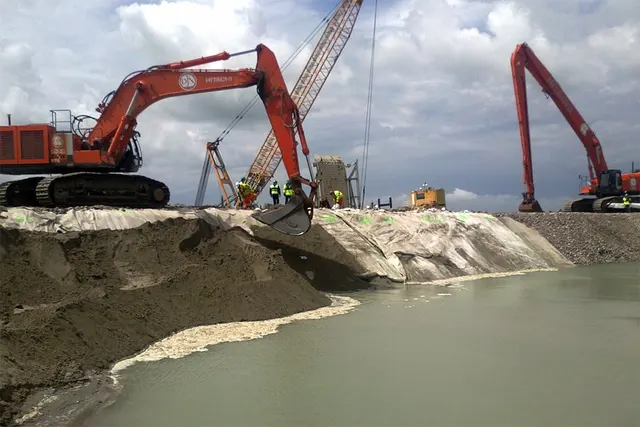
Linkeroever has been a hive of activity for some time now. This Antwerp district plays a key role in the construction of the famous Oosterweel Link. As a partner in the Rinkoniên consortium, Stadsbader will build several new bridges, tunnels and roads over the coming years. Before work can begin, a large number of sites must first be built up, with some reinforced using geogrids.
“An obvious choice, because these earth structures can cost up to 30 to 50% less than other conventional solutions based on concrete,” explains Nicolas Denies, deputy laboratory manager at Buildwise. “Their environmental footprint is also much lower. There is no concrete or steel involved, and no need for large cranes or machinery … Yet this technique is still little used in our country, owing to the lack of a clear framework for designing such earth structures. We have to refer to foreign standards or guidelines, but they are not always impartial and/or consistent, which leads to difficult discussions between clients, design offices and contractors. Internationally, too, there is little knowledge of how this type of reinforcement behaves over the long term under real operating conditions. All of this is a major barrier to the uptake of the technique, even though examples abroad demonstrate its potential to become established.”
Of interest to the entire construction sector
Nevertheless, Lantis found the benefits sufficiently compelling to include the technique of reinforcing certain embankments in the contract specifications. Stadsbader went a step further, also endorsing the proposed use of geogrids on other sites in the project. Nathan Lauwers, ground reinforcement works planner at Stadsbader: “We firmly believe in the potential and benefits of geogrids as reinforcement. However, we too often encounter obstacles because there is no standards framework. In this case, the client itself was asking for it, so we seized the opportunity to apply the technique on a large scale. Lantis also commissioned Buildwise to map the long-term behaviour of the geogrids. A monitoring programme like this is extremely important to us, as it will enable us to optimise future designs for these structures.”
Nicolas Denies adds: “Buildwise was all the more interested in this contract because the entire construction sector will benefit from it. We will be able to use the findings in the federal research project on this topic, which has been under way since 2018 with the FPS Economy and NBN.”
A challenging installation
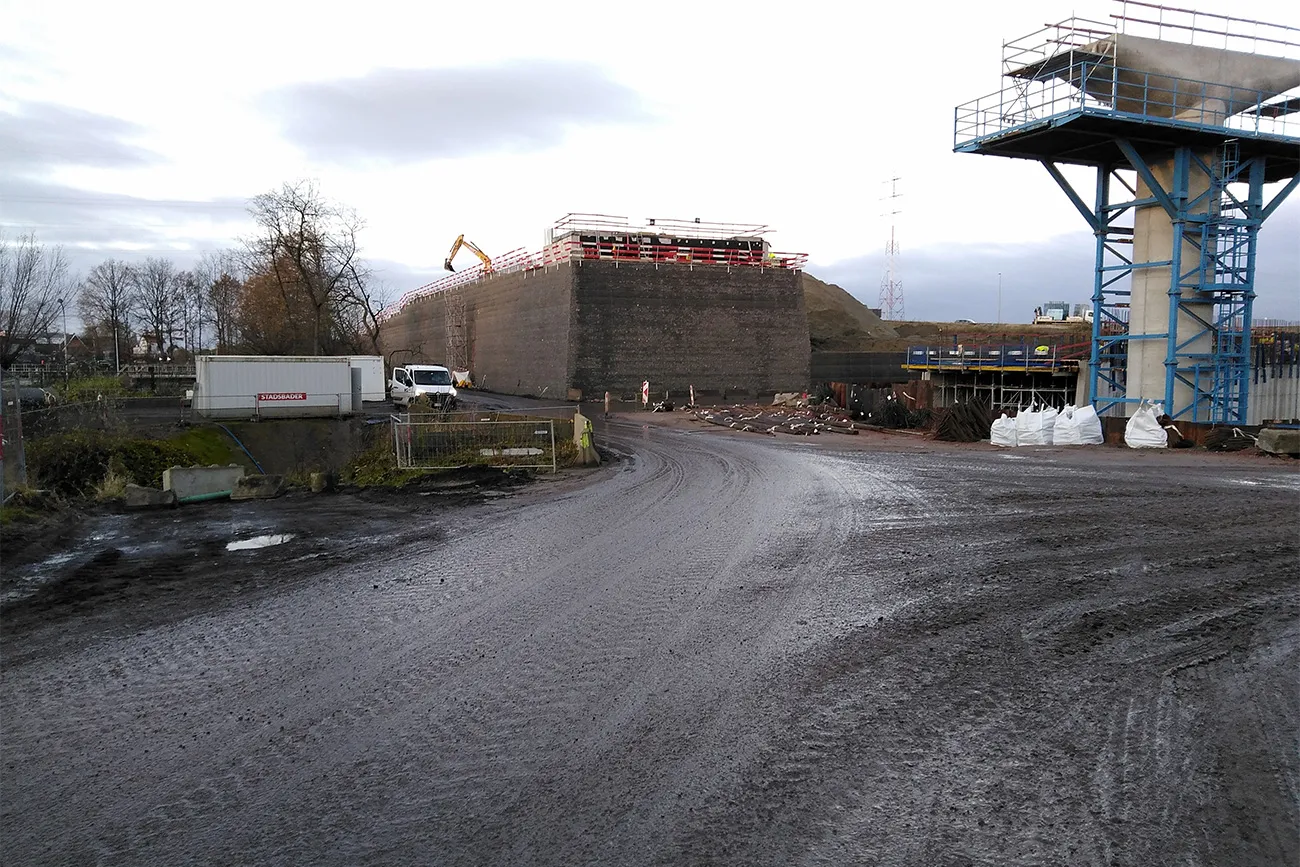
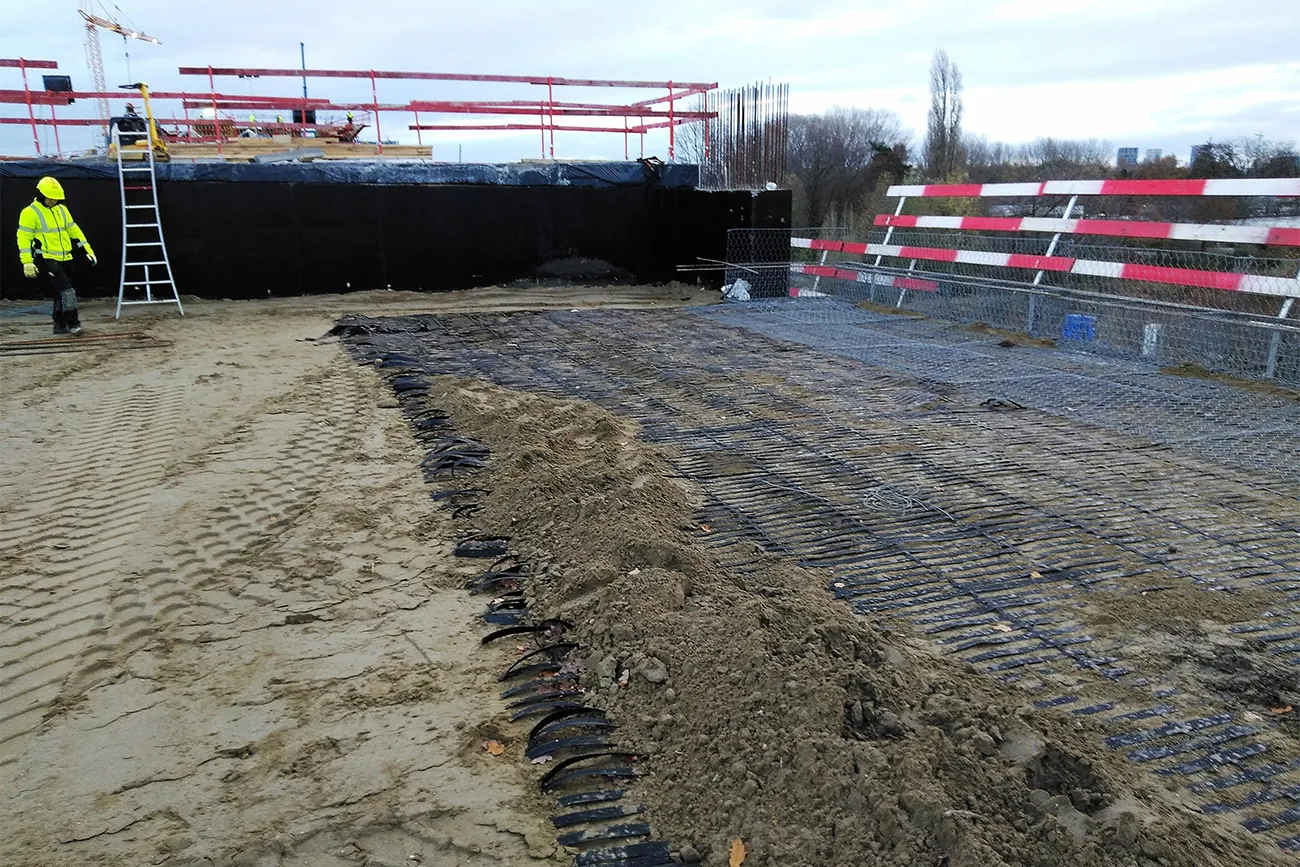
Naturally, the most spectacular construction site was chosen for the monitoring campaign: retaining wall G03 at Linkeroever, Zone Zwijndrecht (between the E17 and the Aquafin wastewater treatment plant). Nathan Lauwers: “An approach ramp and an abutment are being built towards the viaduct, which will carry traffic from the E17 towards Antwerp to the new Scheldt tunnel or the E34. The abutment therefore serves two functions, which is particularly interesting in itself. It is also a 16 m earth embankment, the highest in the project. It consists of 29 layers reinforced with 18 geogrids. We chose the solution proposed by the Italian company Maccaferri. It consists of steel wire baskets containing polyester geogrids coated in polyethylene.”
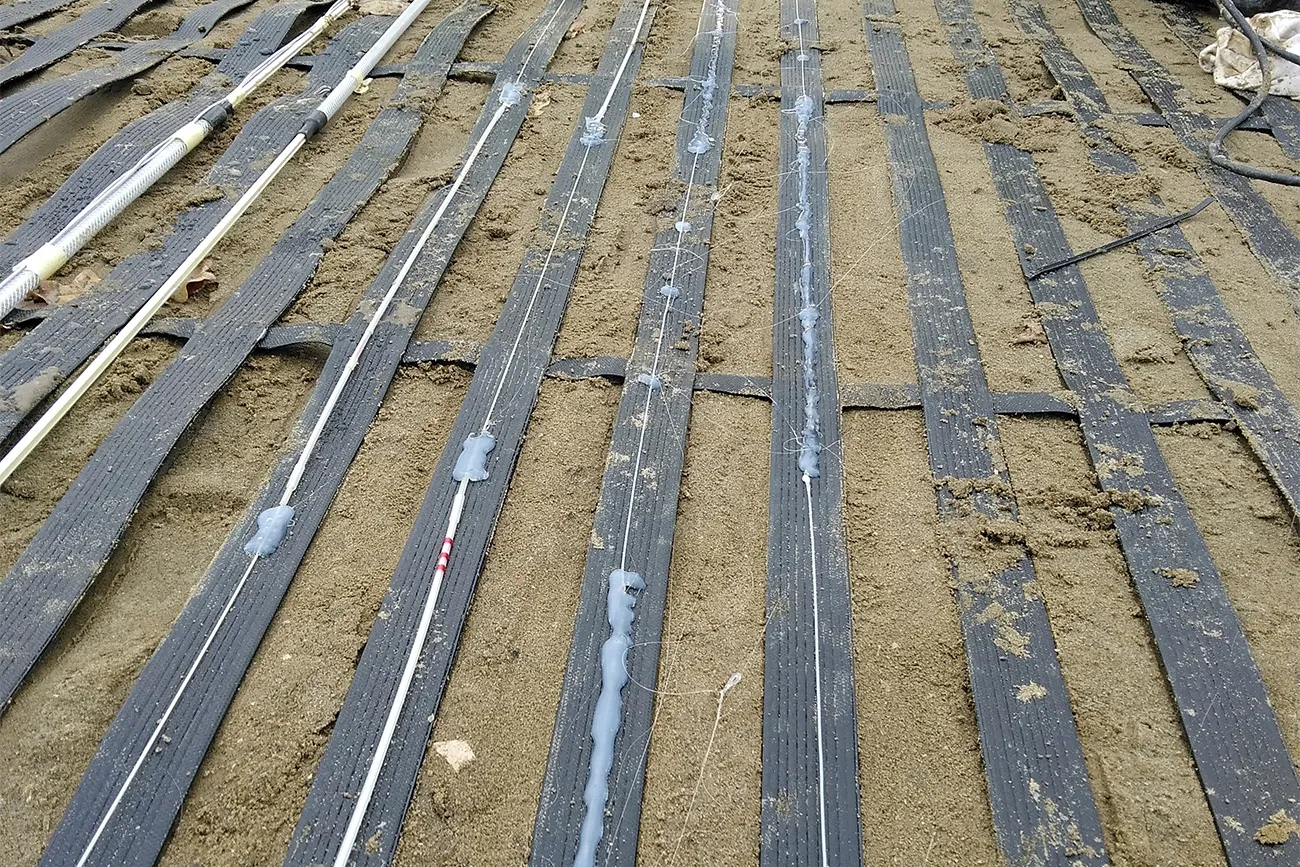
For cost reasons, the decision was made to monitor five geogrids. Fibre-optic cables were therefore placed on the geogrid. “
Nicolas Denies: “It was not always easy, because we had to install these extremely thin, delicate cables on site, sometimes in difficult weather conditions. We also wanted to assess the technical limitations of these sensors, so we made sure to have enough back-ups. We installed several back-ups and several types of fibre optics in each layer. This allows us to evaluate and test the quality of these products.” The practical knowledge gained, including the most suitable sensor model and installation method, will also be incorporated into the VLAIO-funded COOCK project, “Monitoring Structures and Systems with Fibre Optics”. In time, it could lead to the development of robust, ready-to-use products.
An intermittent measurement campaign
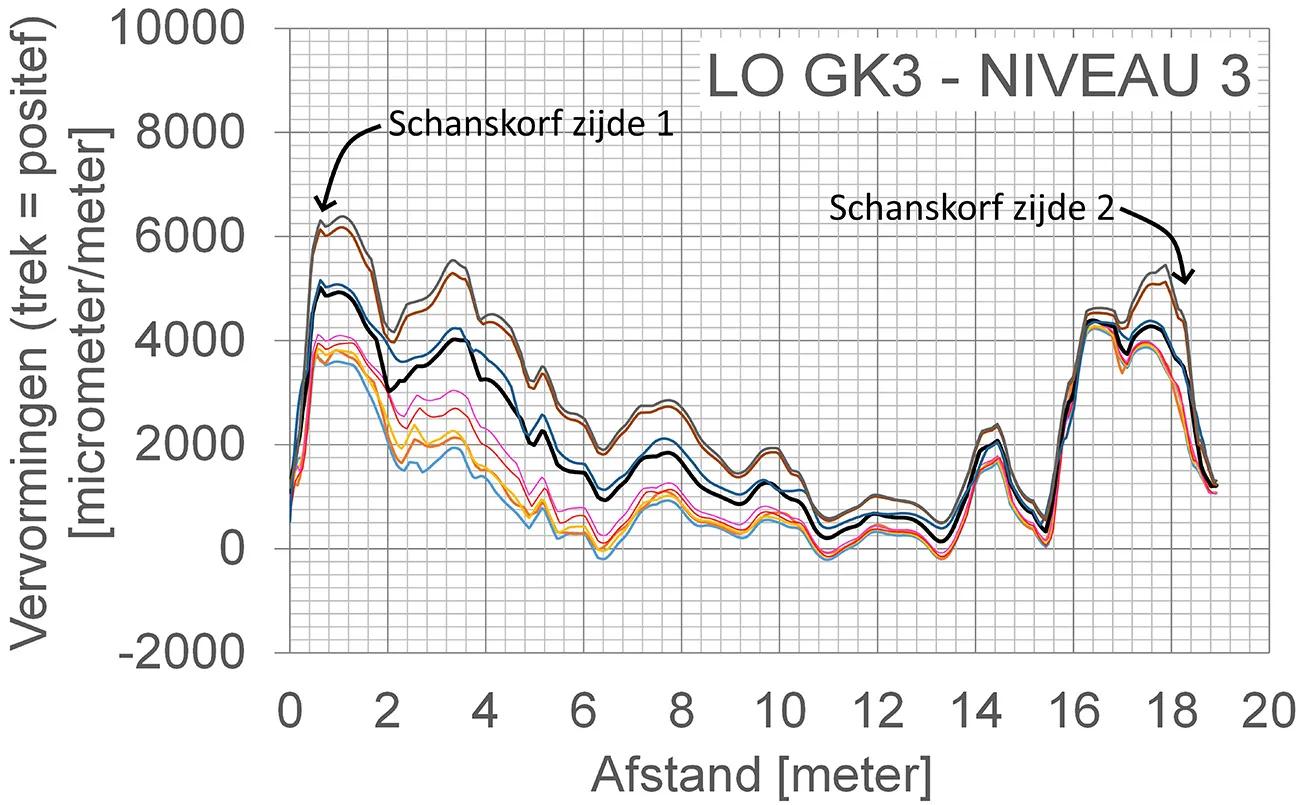
The main aim of the monitoring campaign is to measure strain and deformation in the geogrid from the moment a layer is installed. “In theory, the sensors could be read in real time. However, Lantis opted for an intermittent approach,” explains Nicolas Denies. “While the embankment reinforcement was being carried out, from June to December 2021, the sensors were read twice a month on average. We then moved to a frequency of once a month. The settlement should have largely stabilised after six months, at least in theory. We will therefore continue with two visits a year.”
“The aim is to keep a close eye on the situation so that we can gain a clear picture of strain and deformation, even over the long term.”
Comparative study
Lantis and Stadsbader also want to monitor settlement closely. “On projects of this kind, we always take topographical measurements. A surveyor carries them out periodically, measuring wall movements using small mirrors installed outside the embankment. The Flemish government’s geotechnical department has also equipped the embankment with two settlement tubes. These are horizontal inclinometer tubes through which an inclinometer is passed at regular intervals. The aim is to record settlement in the tubes, and therefore in the embankment. In short, we are monitoring the reinforced embankment in three ways,” says Nathan Lauwers.
Data pave the way for optimisation
The first results are positive and reassuring. The measured strains and deformations match the calculations made by design office Arcadis. Nicolas Denies: “The data will help both the contractor and the design office build up new knowledge, particularly when it comes to optimising structures. On other sites, we may be able to install geogrids that are less stiff or have lower tensile strength.” Nathan Lauwers adds: “We can also study creep, a phenomenon in which deformation increases slowly over the years. Creep characteristics are generally determined through accelerated laboratory tests. This project will therefore allow us to compare those laboratory results with real-world behaviour.”
Could other alternatives be on the horizon?
But the ambitions do not stop there. The parties involved also want to explore the use of cohesive soils. Nathan Lauwers: “At present, we build reinforced embankments using gravel or sand. It would be cheaper, faster and more environmentally friendly to use some or all of the existing soil on each site.”
Nicolas Denies: “Another avenue to explore is circularity. Could recycled aggregates from industry or dredging residues be used, perhaps stabilised with cement or lime? There is still so much we do not know about reinforced embankments. The whole world has high hopes for this promising technique. The design of geotechnical structures is therefore a key part of the Eurocodes revision. Unfortunately, it will be several years before we see the outcome. That is why this monitoring project is so important. It allows us to demonstrate the potential of geogrids to the industry in black and white. Contractors learn more about this new technology, become less dependent on suppliers and gain additional arguments to persuade clients.”
For more information: www.buildwise.be
Question about this story? Ask your question
Keep following this
Get an email when a new story is published. No account needed.
- SubjectGeotextiles