World first: 48 t hybrid crane on a truck
Texte Philippe Selke | Photos Vitrerie Landrieux-Leclercq
FASSI BELGIUM: Stand 604-624-626
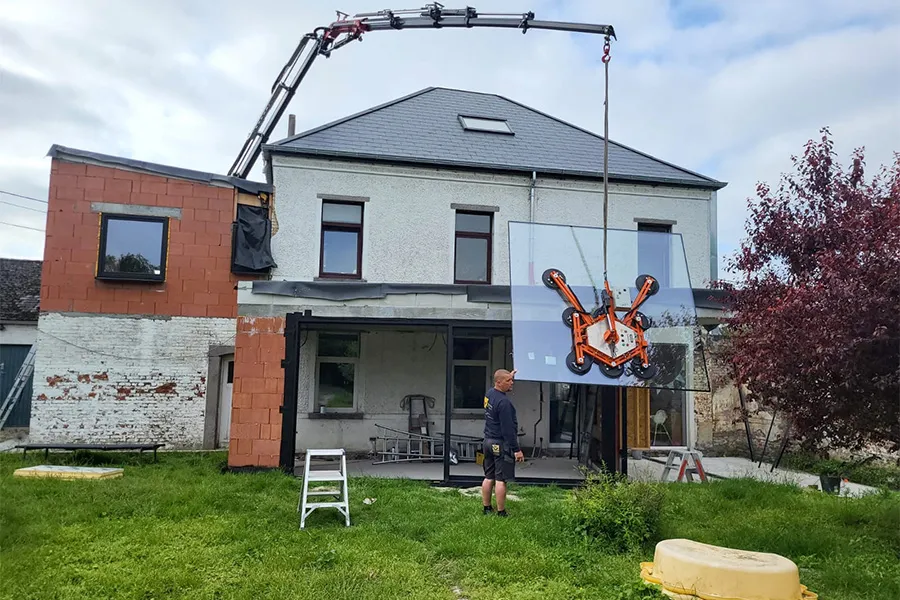
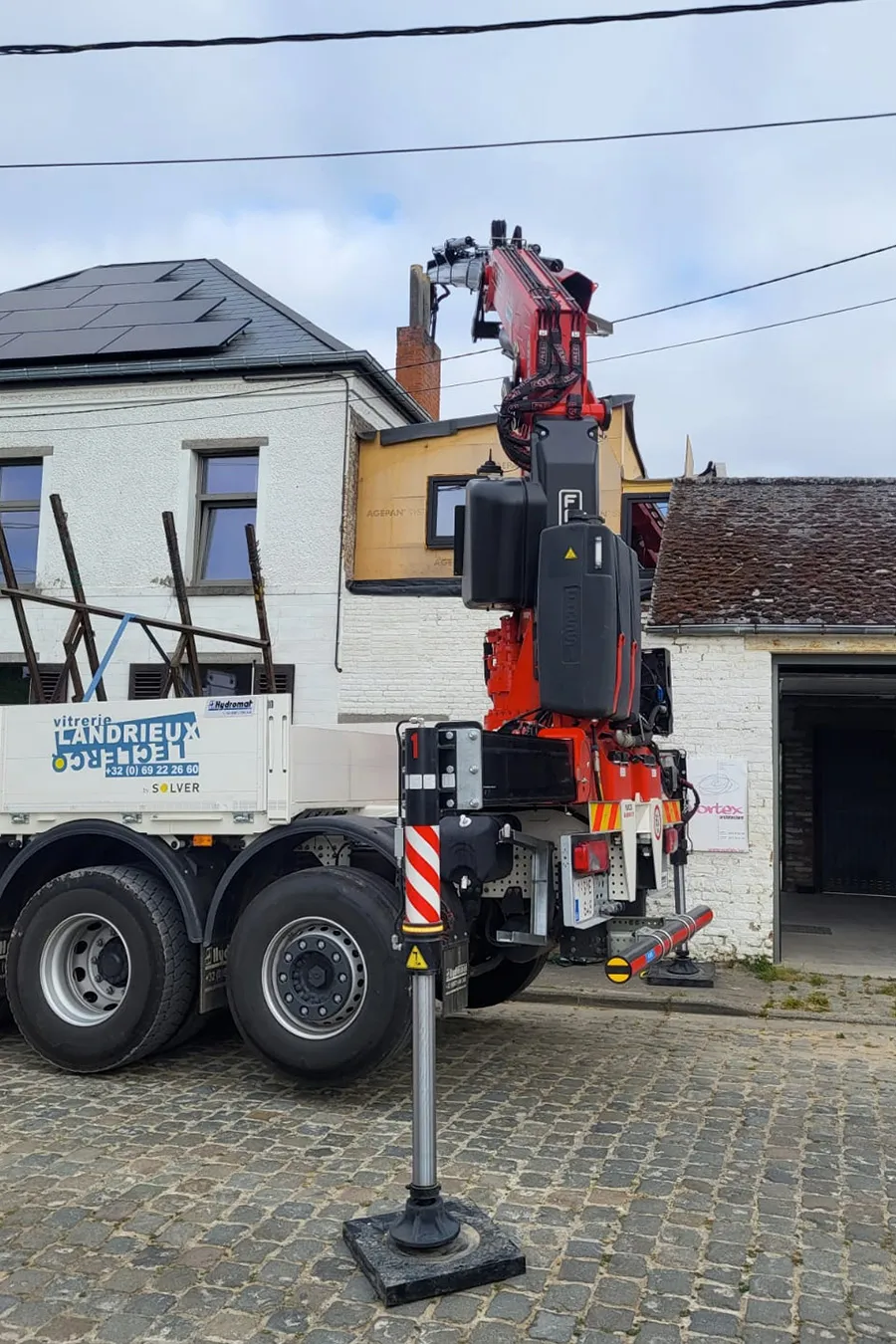
Based in the Fleurus industrial estate in the heart of Wallonia for 3 years, Fassi Belgium recently delivered a 48-tonne hybrid crane mounted on an IVECO truck to Tournai-based glazing company Landrieux-Leclercq. It is powered by lithium batteries, which are recharged either by the truck’s engine while it is moving or via electrical sockets when the vehicle is stationary.
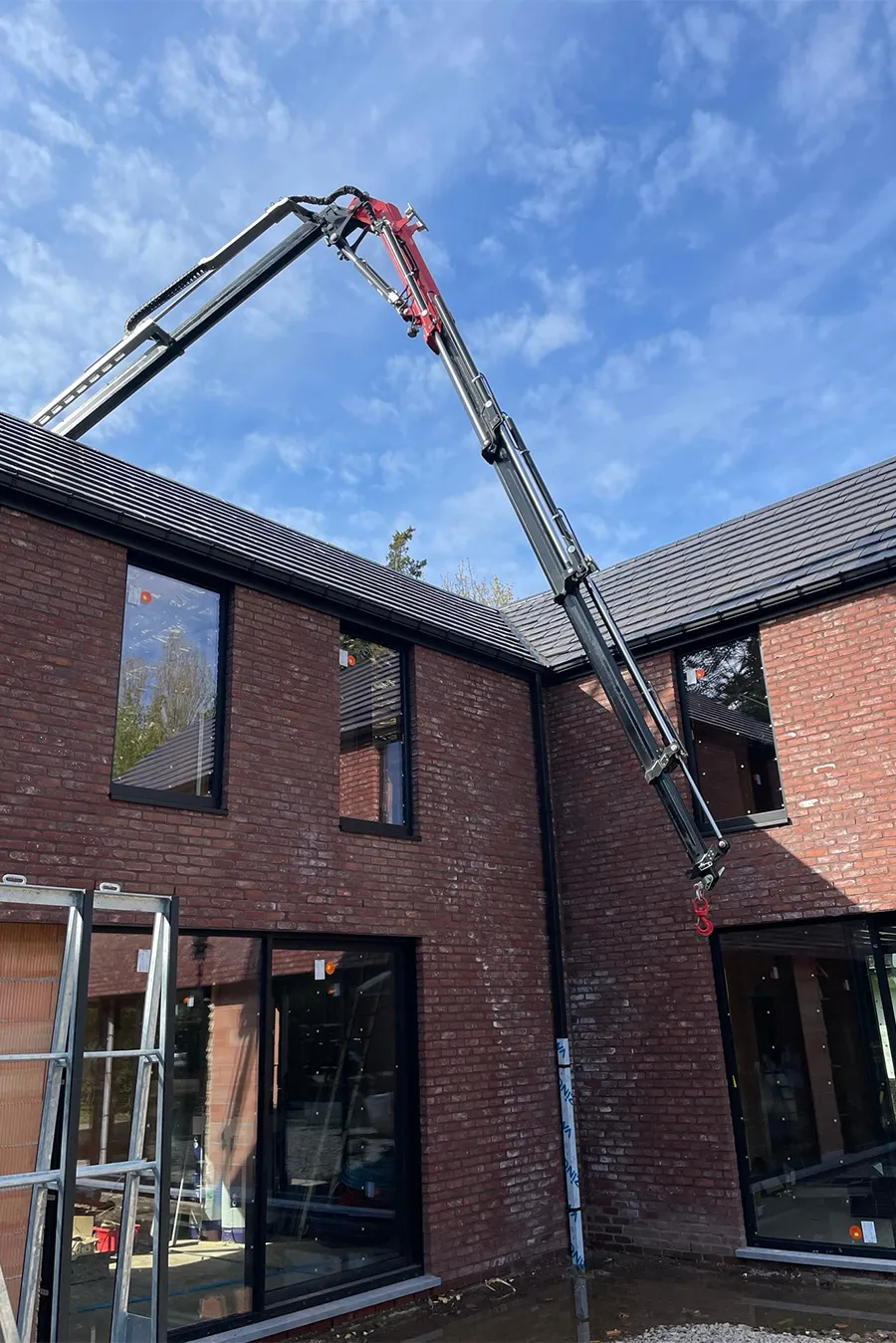
This innovative technology makes it possible to operate the crane in environments where quiet, emission-free machinery is required. Fassi decided to introduce an electric mode on its cranes in response to market demand, mainly in Northern Europe, where exhaust fumes and noise are unwelcome in residential areas. This is precisely one of the main areas of operation for glazing company Landrieux-Leclercq, based in Froyennes near Tournai. Already a Fassi customer, the company needed such a large crane because the biggest panes of glass are generally installed at the rear of properties, requiring a long boom to work from the street. The purchase also made economic sense: although the hybrid crane costs more upfront, it will be much cheaper to run. Managing director Samuel Leclercq explains: “Our commitment to sustainable development and our environmental ethos had already led us to offer our customers all the latest glass products designed to save energy. Now we will also be able to install them in zero-emission mode. And quietly, which is also better for the operator.”
Hybrid Smart Technology
Fassi’s new technology can be applied to a wide range of crane models, from micro cranes to models with a lifting capacity of 40 tm. The system is also safe, as it operates at low voltage (48V-51V). This means operators do not need special training for maintenance, as they would with medium- and high-voltage systems. The system has also been successfully tested to verify compliance with UN ECE Regulation No. 10, which governs electromagnetic compatibility requirements for electrical and electronic components installed in vehicles. The total weight of the Fassi HST system, including the battery pack, is 550 kg.
Two charging methods
The dual charging system uses a 220V single-phase 16A power supply. Charging takes 9 hours if the batteries are completely flat, which is unlikely because they are recharged by the truck’s engine while the vehicle is moving. This means that some charging has already taken place by the time the vehicle returns to base in the evening. The system can also be charged while the crane is working and the AC generator is running.
Fassi’s HST system comprises a 560 Ah battery pack that can provide, in fully electric operation, a range equivalent to 80% of daily requirements. The housing containing the battery pack is fitted with a heater that ensures operation down to -20°C.
Easy to use
The HST is equipped with dedicated software that maximises the use of engine power while reducing hydraulic power loss. The technology can also modulate the hydraulic power required by the crane when the engine reaches its limit.
Cranes fitted with Smart Hybrid technology have a control panel that activates the battery and switches on the various devices. The pump can also be started and stopped using the radio remote control.
The FX902 screen in the truck cab provides the driver with all the information needed to monitor the system while the vehicle is in operation. All the data is also replicated on the radio controller, giving the user the same information while operating the crane.
Question about this story? Ask your question
Keep following this
Get an email when a new story is published. No account needed.
- ThemeConstruction machinery and equipment
- SubjectEvents