IS GREEN ONLY THE COLOUR OF MONEY? What really happens when a building is demolished
For a long time, on construction sites and elsewhere, green had a simple meaning: money. Cutting transport costs, reducing waste disposal fees, finishing the work more quickly. It was all about costs.
Today, green tells a different story: one of sustainability, the circular economy and urban regeneration. Yet money is still part of the picture. Recovering materials rather than disposing of them is often the more economical choice. Perhaps this is where the economic and environmental arguments finally stop going their separate ways.
Let’s start with a simple observation: a building due for demolition is not just a pile of rubble to be removed. It is a genuine urban mine, hidden in the walls of every building, warehouse or bridge that has reached the end of its life. Concrete, steel, bricks: all these materials took resources and investment to produce, and no one wants to pay a second time to send them to landfill.
This is where what could be called the “crushing duo” comes in: on the one hand, the demolition grapple; on the other, the crusher bucket. Both are made by MB Crusher.
The MB Crusher concrete cracker grapple works with surgical precision. It demolishes only where necessary, avoids unnecessary destruction and prepares the materials for the next stage. Paired with an MB Crusher sorting grapple, it makes material sorting even faster and more precise.
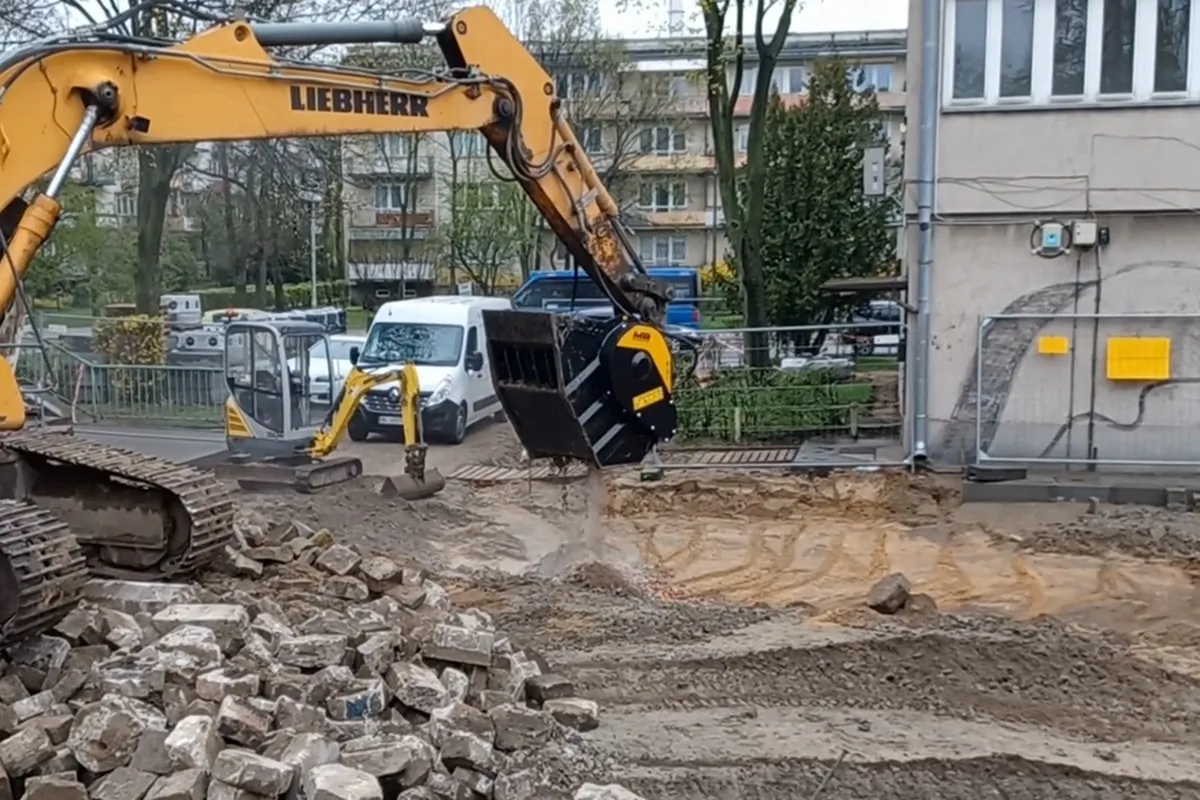
The crusher bucket then gives the materials a second life. Concrete from the demolition stays on site, is crushed to the required size and becomes new aggregate, ready for reuse. When a project calls for a specific grading, the MB Crusher screening bucket completes the process by grading the material directly on site.
This approach is attracting growing interest, particularly in urban areas. Today, many demolition projects take place close to homes, schools, hospitals or buildings that need to remain operational throughout the works.
In these situations, precision is essential, but so are noise, vibration and dust control.
Controlled demolition minimises impacts and helps protect neighbouring structures. The MB Crusher misting system, which can be fitted to crusher and screening buckets, reduces dust emissions, improving working conditions while limiting disturbance for local residents.
So much for the theory.
But what does it look like on site?
1. Germany: demolishing a garage without disturbing the neighbour
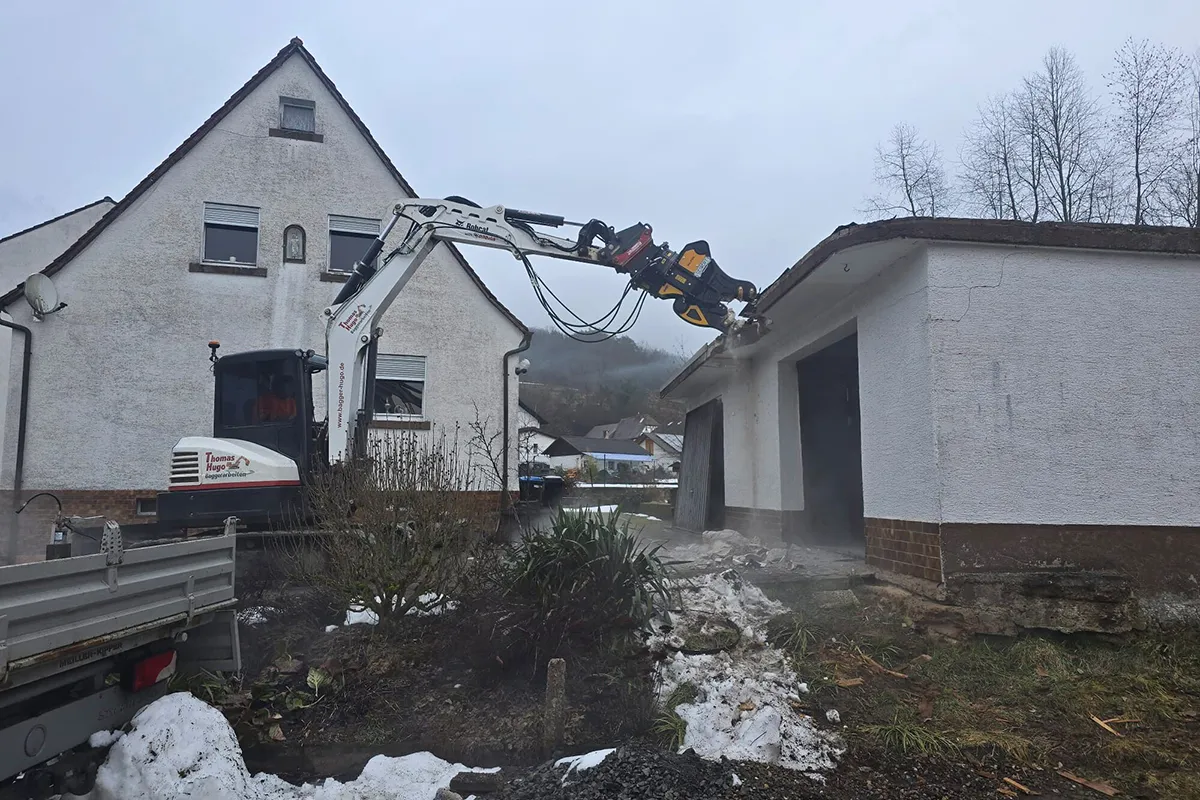
For the partial demolition of a double garage, Sulzbach am Main-based contractor Thomas Hugo Baggerarbeiten chose to use MB Crusher’s MB-P380 concrete cracker grapple, mounted on a 5.5-tonne Bobcat E55 excavator. The aim was to demolish one half of the garage selectively, without damaging the adjoining section.
After the preparatory work, which included removing the garage door, propping the slab, stripping the roof waterproofing and cutting the connection between the two structures, concrete demolition began.
Using a hydraulic breaker was ruled out immediately because of the risk of vibration to the neighbouring building. The MB-P380 enabled precisely controlled demolition without vibration. Its integrated cutting blades severed the steel reinforcement during demolition. Concrete and steel were therefore cleanly separated and reduced on site to a size suitable for crushing.
In other words, the concrete cracker grapple did more than demolish: it also helped preserve the value of the materials. Quality recycling always starts with quality demolition.
2. Poland: when materials no longer leave the site
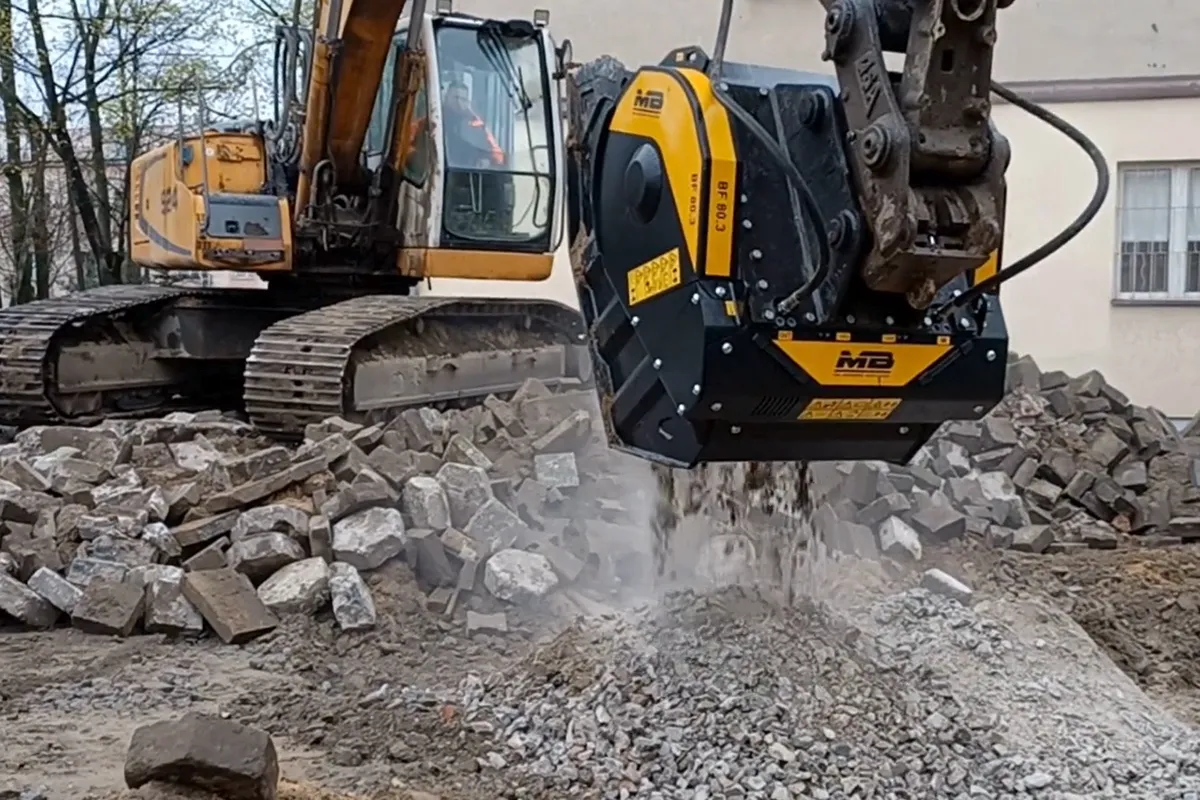
Cutting operating costs by 30 to 40% by making use of material that, until recently, was considered nothing more than waste. That is the result achieved by MBKOP, a Polish company specialising in demolition and earthworks, by recycling rubble directly on site with an MB Crusher BF80.3 crusher bucket.
The change came from removing one of the main barriers to productivity: dependence on transport, landfill sites and aggregate suppliers. Today, demolition materials are crushed and immediately reused on site for sub-base layers, backfill or ground stabilisation, without ever leaving the site.
The benefits are numerous: faster project delivery, fewer lorries on the roads, no landfill costs and no need to buy new aggregates.
So, what is “green demolition”?
Above all, it means recovering as much material as possible exactly where it is, without transporting it elsewhere before bringing in new materials. This means less waste sent to landfill, fewer transport movements and less quarrying to produce virgin materials.
This approach also supports targets set by many countries, which require recovery rates of over 70% for construction and demolition (C&D) waste, while public procurement encourages, or even requires, the use of recycled materials.
And to return to our opening play on words: green demolition helps keep more “green” on site… in every sense of the term.
Een zakelijke vraag aan MB Crusher? Get in touch
Companies in this story

Keep following this
Get an email when a new story is published. No account needed.
- SubjectEquipment and machinery
- CompanyMB Crusher