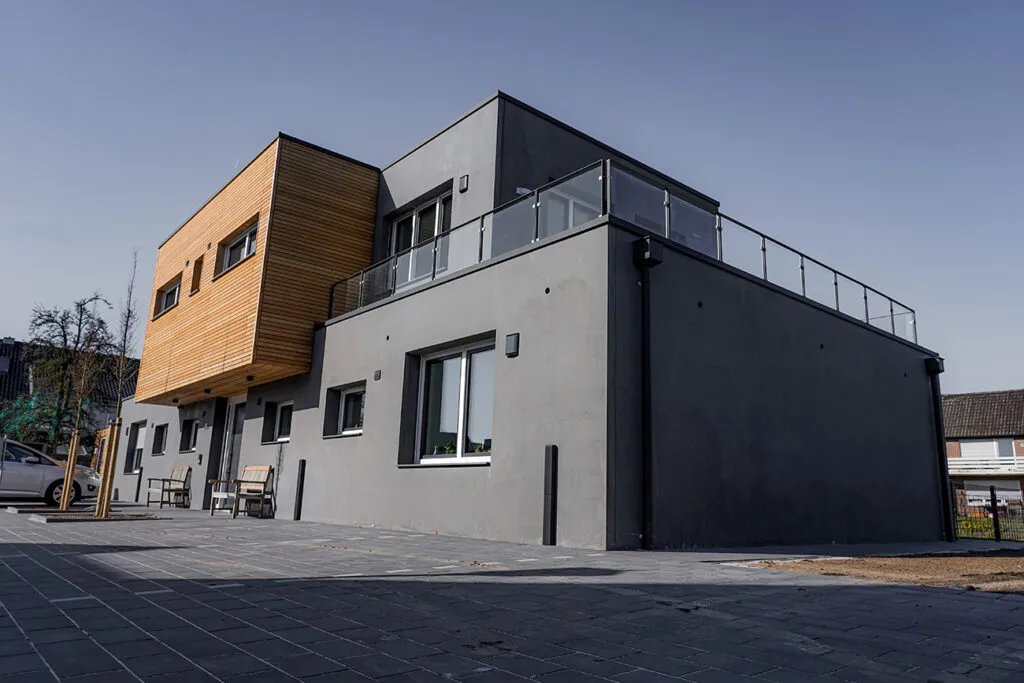
Büscher builds a brand-new house using 75% recycled concrete and demolition waste
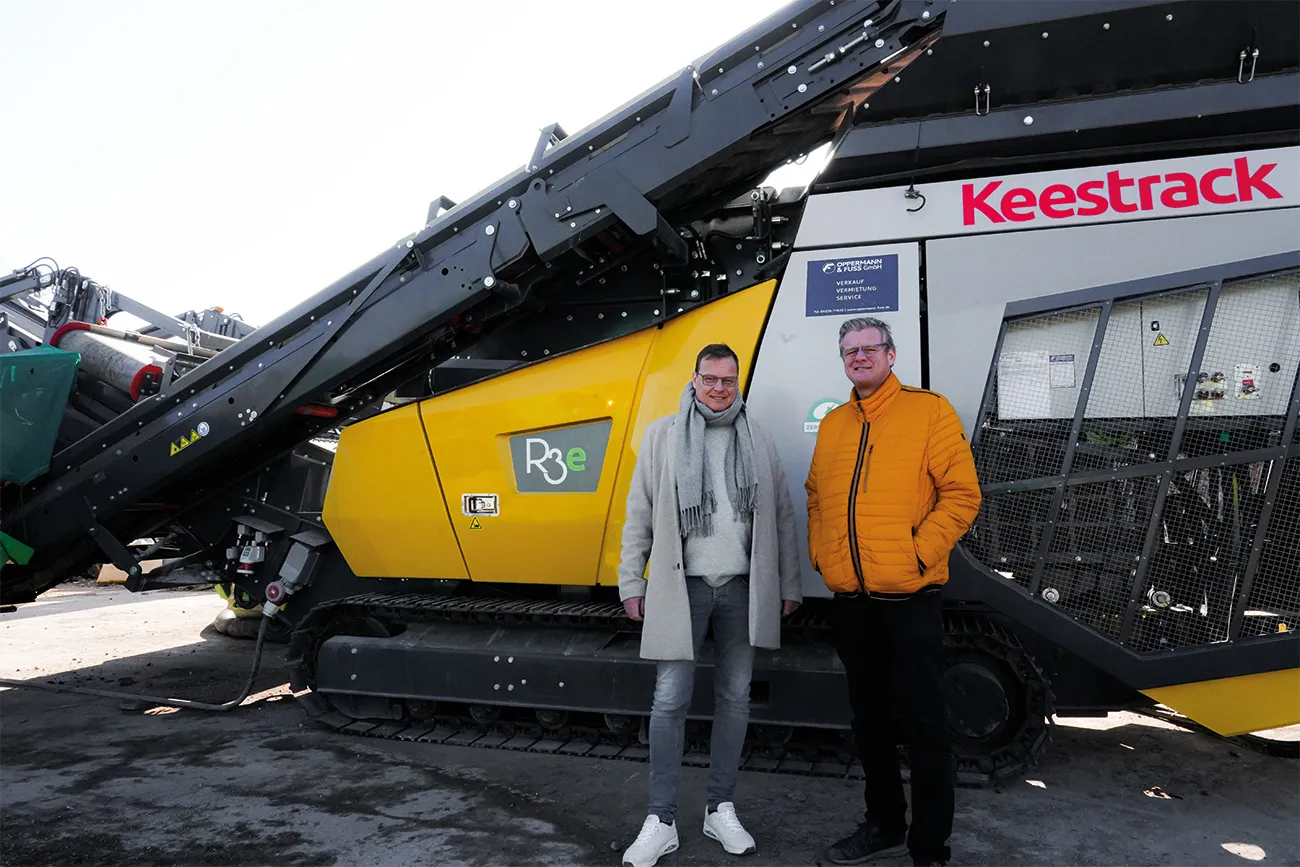
Keestrack’s fully electric, zero-emission crushing and screening equipment ensures complete recycling, turning demolition waste into sustainable building materials.
German company Büscher started out in 1961 as a ready-mix concrete plant, later expanding its business to include a container service. Today, many years later, it is the first company in the world to build an entire house using 75% recycled construction and demolition waste. The load-bearing and non-load-bearing elements of the internal walls are made from 100% recycled aggregates.
The company has not only proved that this is possible, it has also obtained approval from the Deutsches Institut für Bautechnik (DIBt). The German Institute for Building Technology has approved the use of up to 100% recycled aggregates, including crushed sand similar to Type 3, in precast load-bearing and non-load-bearing internal wall elements in exposure classes XC1 and X0 (dry).
The concrete mix has changed
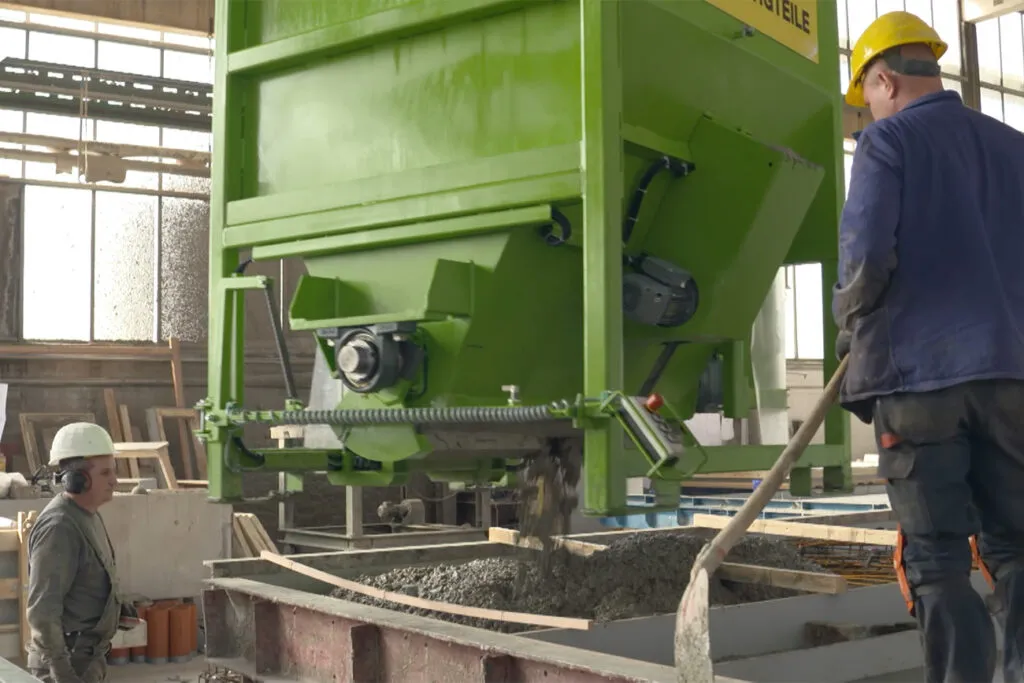
In 1961, Büscher made concrete like everyone else, using gravel, sand, cement and water. Today, the company has changed the mix, using 100% construction and demolition (C&D) waste to completely replace the sand and gravel and produce precast load-bearing and non-load-bearing internal wall elements.
Through its container service, Büscher receives a large volume of C&D waste, which it would normally recycle into aggregates for road construction. As this material is difficult to sell and available in large quantities, brothers Wolfgang and Hans-Jürgen Büscher began looking for ways to reuse it. They hit on the idea of using it as a raw material for precast concrete and concrete elements.
It seemed like a good idea from an environmental perspective, but convincing industry specialists and the authorities that it could represent the future was difficult. Securing certification for 100% recycled precast concrete was a challenge: it took 8 years of research and development to obtain approval, as most people did not believe it was possible. «Concrete specialists, laboratories and certification experts were deeply sceptical that it could be done. They all said it was impossible and illegal», says Wolfgang Büscher.
Büscher asked researchers at laboratories and universities to prove scientifically what the material could and could not do. The company set out what it wanted to achieve with the material and left them to carry out the research to establish whether it could pass the tests.
«All the scientific research has now been completed, and it shows exactly what can be done with 100% recycled precast concrete and concrete elements. The new material works perfectly, and Büscher has changed its mix.» adds Hans-Jürgen Büscher.
Dr. Wolfgang Breit of the Technical University of Kaiserslautern concludes: «the quality is good because Büscher takes the right steps, from receiving the construction and demolition waste, through processing the material, to using it in precast concrete and concrete elements.».
The main advantage of this certified production process is its efficient use of resources. The company uses local, readily available and low-cost C&D materials to make a durable, climate-neutral product with lower CO2 emissions, while also saving on transport costs by using materials that are available locally. ««We want to share our process, and would be delighted to hear from other concrete plants, recycling companies and anyone else interested in sustainable construction using secondary building materials. The construction industry is undergoing a global transformation. New approaches are needed to ensure that used building materials do not end up as waste. With Büscher concrete elements, we can do this, and we are authorised to do so», says Thomas Overbeeke, Managing Director of Büscher. No costly raw materials are used, which also means a lower price for the finished products: a real win-win.» explains Thomas Overbeeke, Operations Manager at Büscher.
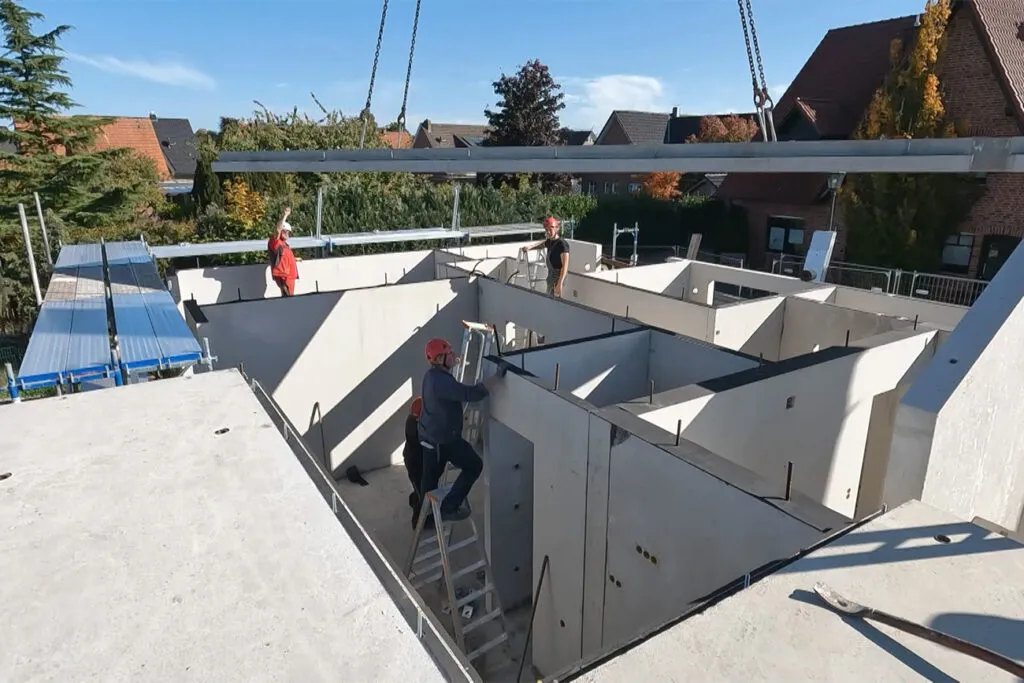
It took eight years of scientific research to prove that it was possible to build a sustainable house using entirely recycled materials, and at lower cost. But it took only 4 months to build the entire three-family house using precast elements ready for painting. Plumbing and electrical services are fully integrated into the precast panels, which have a smooth surface and therefore need no plastering. The first house has now been built with 100% recycled natural mineral substitutes in the load-bearing and non-load-bearing elements of its internal walls. And when the time comes to demolish it, it will be recycled into new concrete using the Büscher method. A perfect example of the circular economy!
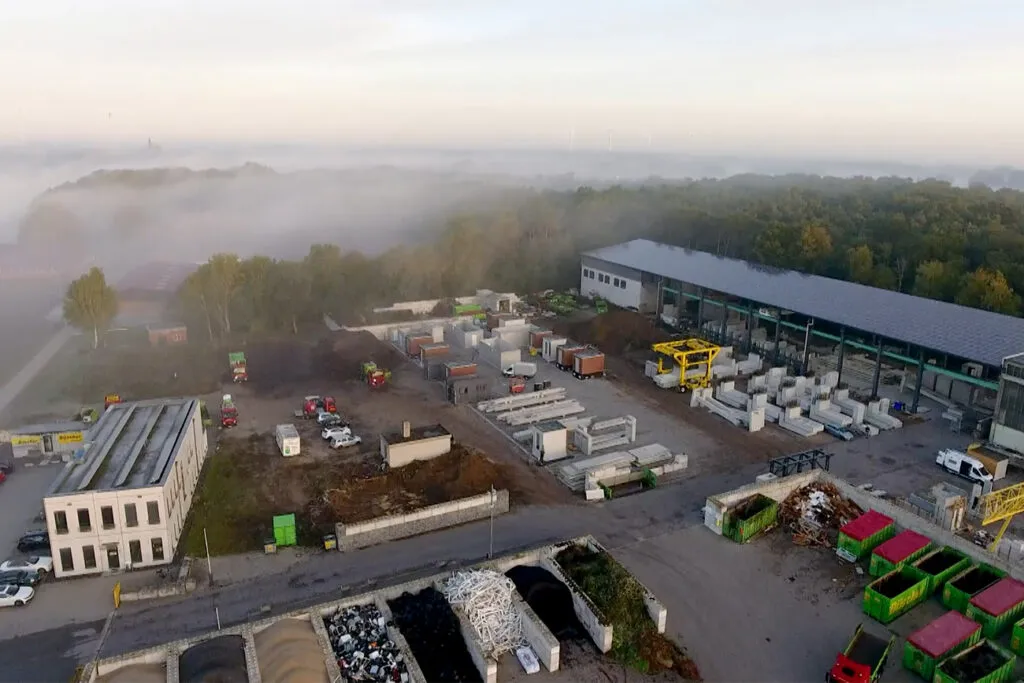
Büscher clearly aims to minimise its environmental footprint and close the materials loop in support of a circular economy. This is also why its plant and recycling site are powered by solar panels. The decision to use Keestrack crushing and screening equipment was driven by the same thinking. Oppermann & Fuss, Keestrack’s dealer in Germany, advised Büscher on the ZERO equipment best suited to its applications and capacity. Selecting the right options is also essential for this specific application.
Zero drive
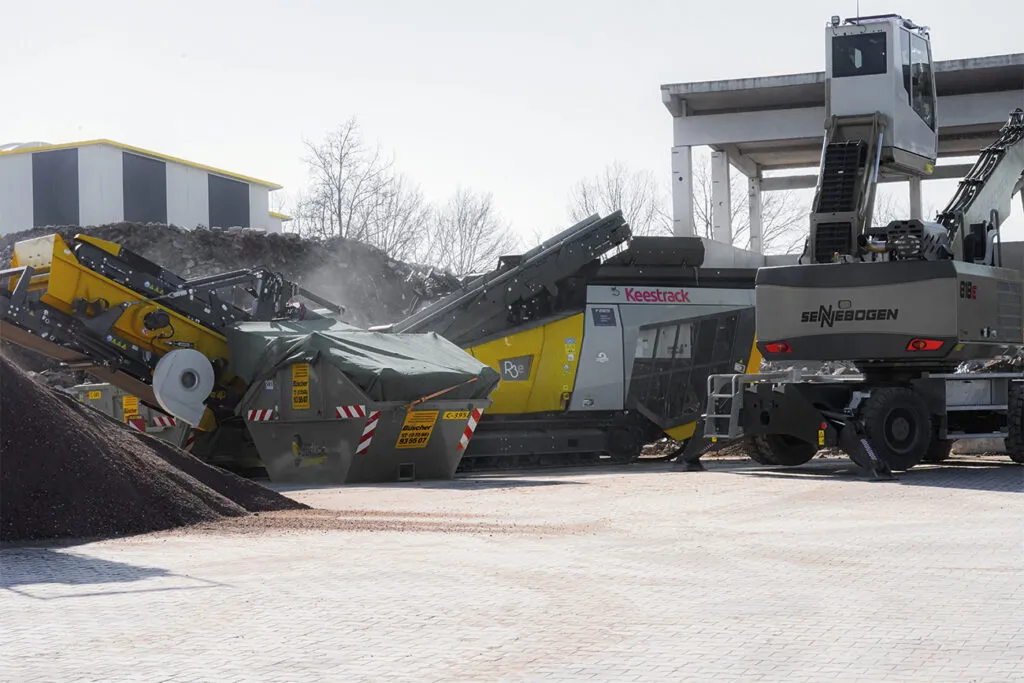
A sustainable product should clearly be made using sustainable production equipment. Büscher’s site is equipped with solar panels supplying up to 323 kW/h of renewable electricity, which is used to power the concrete plant as well as the R3e ZERO impact crusher and K4e ZERO screen. Both Keestrack machines are fully electric and powered by renewable energy, with no onboard combustion engine.
As electric motors drive most of the mobile crushing and screening equipment and power some of the hydraulic systems required, both Keestrack machines operate with ZERO CO2 emissions. Keestrack is known as an innovative company that adopts electric equipment ahead of the market. Most of the Keestrack product range is available in ZERO versions.
When connected to the grid, as they are at Büscher’s recycling site, where they use renewable energy from photovoltaic solar panels, the R3 and K4 produce zero carbon emissions. Energy costs will be around 152 kWh. Operating and maintenance costs are significantly lower because there is no onboard engine to maintain.
The R3e ZERO impact crusher and K4e ZERO screen
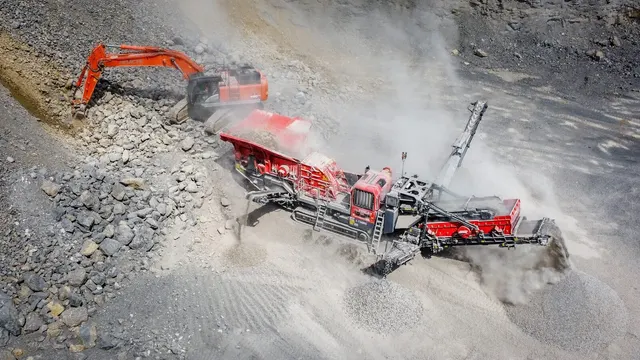
The R3 impact crusher’s innovative technology, safety features and design have won several European design awards, including the Red Dot Award. This highly compact, easy-to-transport impact crusher is available in diesel-hydraulic, electric plug-in (with a backup diesel generator) and ZERO versions (fully electric plug-in with no backup generator). Its capacity is up to 250 tonnes per hour.
Büscher chose the ZERO versions to minimise environmental impact, as the machines can operate with no carbon footprint when powered by the company’s own solar energy.
The R3e ZERO is equipped with a vibrating feeder and a 1,200 mm x 920 mm pre-screen to optimise crushing results and minimise wear, a feed opening of 770 mm x 960 mm (H x W), a rotor diameter of 1,100 mm and a rotor width of 920 mm. Fitted with a recirculating conveyor and a 3,100 mm x 1,400 mm precision screen in closed circuit, the crusher produces a graded aggregate. The installed air separator removes plastic, wood and paper contamination, while the overband magnet separates metals. The R3e ZERO weighs 32 t, and its 125 A plug-out socket powers the connected 28 t K4e ZERO.
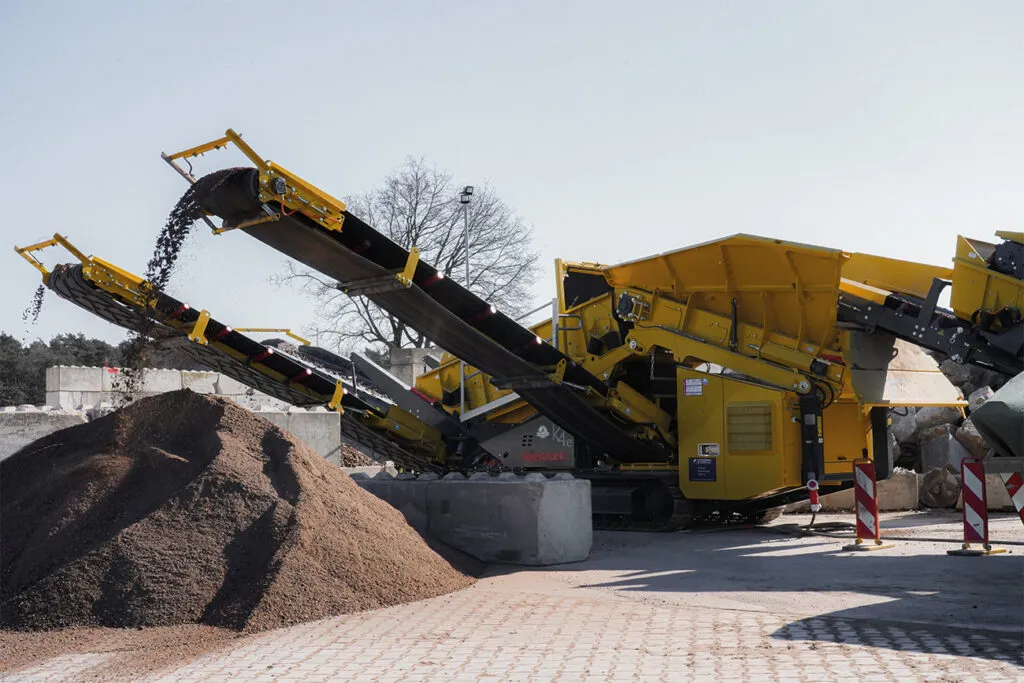
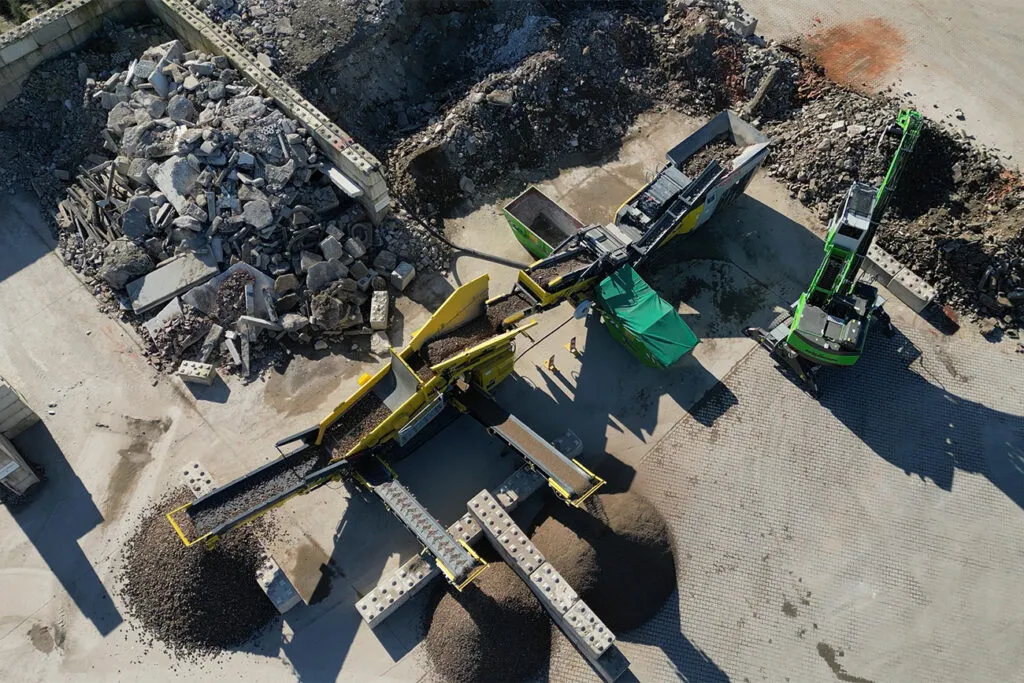
The K4e ZERO offers high productivity, with a capacity of up to 350 t/h. Its 4,200 mm x 1,500 mm double-deck screen, heavy-duty standard apron feeder and hydraulically adjustable screening angle give it excellent screening performance. The many options and screening decks available allow the K4 to be configured for every task. At Büscher’s recycling site, the conveyors for the fine and medium fractions were placed on the same side of the screen to improve access for the wheel loader.
Every Keestrack machine is designed to provide good service access, minimising maintenance and repair downtime. The Keestrack ZERO range has no onboard engines, which significantly reduces maintenance requirements.
Both Keestrack machines at Büscher are equipped with remote controls, allowing the crusher and screen to be operated from the excavator. They both have an integrated water spray system that can be used when dust levels are too high. Both are also fitted with the Keestrack-er UMTS system. This telematics software provides real-time data and analysis. It allows users to check the machines’ locations and confirm that they are operating correctly. Every aspect of a machine can be checked, and software updates can be carried out remotely if needed. Diagnostic tests can be run on all components, including the feeder, screen, crusher and conveyors. Keestrack-er also works very well for maintenance planning by Oppermann & Fuss, helping to keep the machines in optimal condition.
Question about this story? Ask your question
Keep following this
Get an email when a new story is published. No account needed.
- ThemeBuilding with less carbon
- SubjectEquipment and machinery